

The pork shoulder hit 145°F hours ago, which the chart on the fridge says is safe. Then you tried to pull it and got slices, not shreds. Pulled pork has two finish lines, and the one everybody quotes is the wrong one to cook to.
The 60-Second Answer
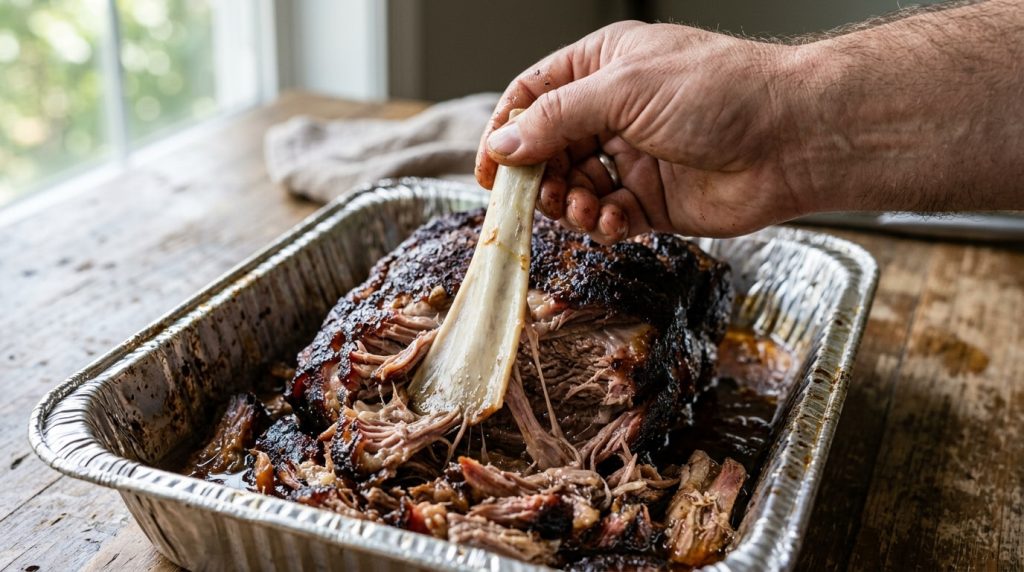
A whole pork shoulder is safe at 145°F with a 3-minute rest, per USDA. It only pulls between roughly 195°F and 205°F, with 203°F a good place to start checking. The confirmation is not the display: it is a probe sliding into the thickest muscle with no resistance, and a blade bone that twists free with two fingers.
Why 145°F Is Not Enough Here
145°F is a safety floor for whole-muscle pork: chops, tenderloin, roasts, and yes, technically a shoulder. (Chops and roasts are covered in what temp is pork done.) Below that number you have a food-safety problem. Above it you have a texture problem, because a pork shoulder is one of the most collagen-heavy cuts on the animal.
Collagen is what holds those hard-working muscles together, and it does not soften at 145°F. It needs sustained heat well into the 190s before it converts to gelatin, which is what coats the shreds and makes pulled pork taste juicy rather than dry and stringy. That is why a shoulder pulled at 165°F slices cleanly and refuses to shred, and why the same shoulder 40 degrees later falls apart around the bone.
| Number | What it means | Source |
|---|---|---|
| 145°F + 3 min rest | Safe minimum for whole-muscle pork, including shoulder | USDA FSIS |
| 160°F | Safe minimum for ground pork (not a shoulder figure) | USDA FSIS |
| 195–205°F | Where collagen has rendered and the meat shreds; texture, not safety | Cooking practice |
| 165°F | Reheat temperature for leftover pulled pork | USDA FSIS |
| 140°F | Minimum holding temperature while it waits to be served | USDA FSIS |
Where to Measure
Go into the thickest part of the shoulder from the side, keeping the probe clear of the blade bone. Bone conducts heat faster than muscle and will hand you a reading 5 to 10 degrees higher than the meat around it, which is how a shoulder gets pulled early.
Take two or three readings in different spots. A boston butt is not uniform, and the lower of two honest readings is the one to cook to. If a probe lands in a fat seam it also reads high, so a single number that suddenly jumps 8 degrees is usually a bad placement rather than a breakthrough.
The Stall, and What to Do About It
Around 150°F to 170°F the temperature stops climbing. This is evaporative cooling, not a stuck fire: moisture leaving the surface carries heat away as fast as the cooker delivers it. On a big shoulder the stall can last three hours.
Wrapping in foil once the bark has set pushes through it fastest and steams the bark soft. Butcher paper is gentler on the bark and still shortens the cook. Leaving it unwrapped gives the best bark and the longest timeline. None of the three is wrong, but cranking the pit to 325°F to beat the stall dries the outer inch before the inside has rendered.
Probe Tender and the Bone Test
Inside the 195°F to 205°F window, stop watching numbers and start testing feel. The probe should go in like it is entering softened butter, with a brief push through the bark and nothing after it. Then reach for the blade bone: on a finished shoulder it twists and lifts out clean. If it drags meat with it, give the shoulder another 30 to 45 minutes and test again.
Boneless shoulders lose that second test, which makes the probe check the only one you have. Check four spots instead of two.
Rest Before You Pull
Let it sit, wrapped, for at least 30 to 60 minutes before shredding. Pulling it straight off the cooker at 203°F drives steam and rendered fat out onto the board, which is exactly the moisture that would have coated the shreds.
If you need to hold it longer, keep it above 140°F: a cooler preheated with hot water and packed with towels will hold a wrapped shoulder in that range for several hours, the same faux cambro method used for ribs and brisket. What you must not do is let it coast down to lukewarm on the counter for a few hours and then serve it, because 40°F to 140°F is the range where bacteria multiply fastest.
Sauce, Vinegar, and the Bark
Save the bark. Chop the darkest outside pieces and mix them back through the shreds instead of discarding them; that is where most of the smoke and rub flavor lives. Add liquid after pulling rather than before, whether that is a thin vinegar sauce, apple juice, or the defatted drippings from the wrap. A shoulder that pulled well needs very little.
For the cook itself, our low and slow pork shoulder guide covers the rub, the fire, and the timeline, and there are dry blends sorted by fire temperature in the homemade BBQ seasoning collection.
Leftovers
Cooked pulled pork keeps 3 to 4 days in the refrigerator and 2 to 6 months in the freezer for best quality. Reheat to 165°F, ideally with a splash of liquid in a covered pan so it steams rather than dries. The method-by-method comparison is in how to reheat pulled pork, and if it has to wait instead, see how to keep pulled pork warm. If it has been in there a while and you are unsure, run the checks in how to tell if pulled pork is bad.
The Bottom Line
145°F makes pork safe; 195°F to 205°F makes it pull. Measure the thickest muscle away from the bone, confirm with a probe that meets no resistance and a blade bone that twists free, rest 30 to 60 minutes, hold above 140°F, and reheat leftovers to 165°F.
Frequently Asked Questions
Can I pull pork at 190°F?
Sometimes, on a fatty shoulder that has been in the 180s for a long time. More often 190°F still fights the probe. Treat 195°F as the earliest point worth testing, and let feel make the call.
My pork hit 205°F and still will not shred. What went wrong?
Usually a thermometer error or a probe in a fat seam or against bone. Check the thermometer in ice water (it should read 32°F), then re-probe three fresh spots. The second most common cause is a cook that raced there too fast, leaving collagen without time to render.
Does resting lower the temperature too much?
A wrapped shoulder loses heat slowly and often climbs a few degrees first from carryover. An hour wrapped on the counter still leaves it far above the 140°F holding floor.
Is pink pulled pork safe?
Pink next to the surface of smoked pork is a smoke ring, a reaction between smoke gases and the meat, not undercooking. On a shoulder that reads 200°F throughout, that color is expected.
Related Guides
- What Temp Are Ribs Done? Safe vs Tender Explained
- How to Tell if Pulled Pork Is Bad
- Low and Slow BBQ Pork Shoulder
- How to Tell if Pork Is Bad
Never Throw Out Good Meat Again
Get the one-page BBQ cheat sheet: fridge and freezer times for every cut, safe temperatures, and the spoilage signs that are false alarms. Free, no spam.
No spam, and you can unsubscribe any time.