
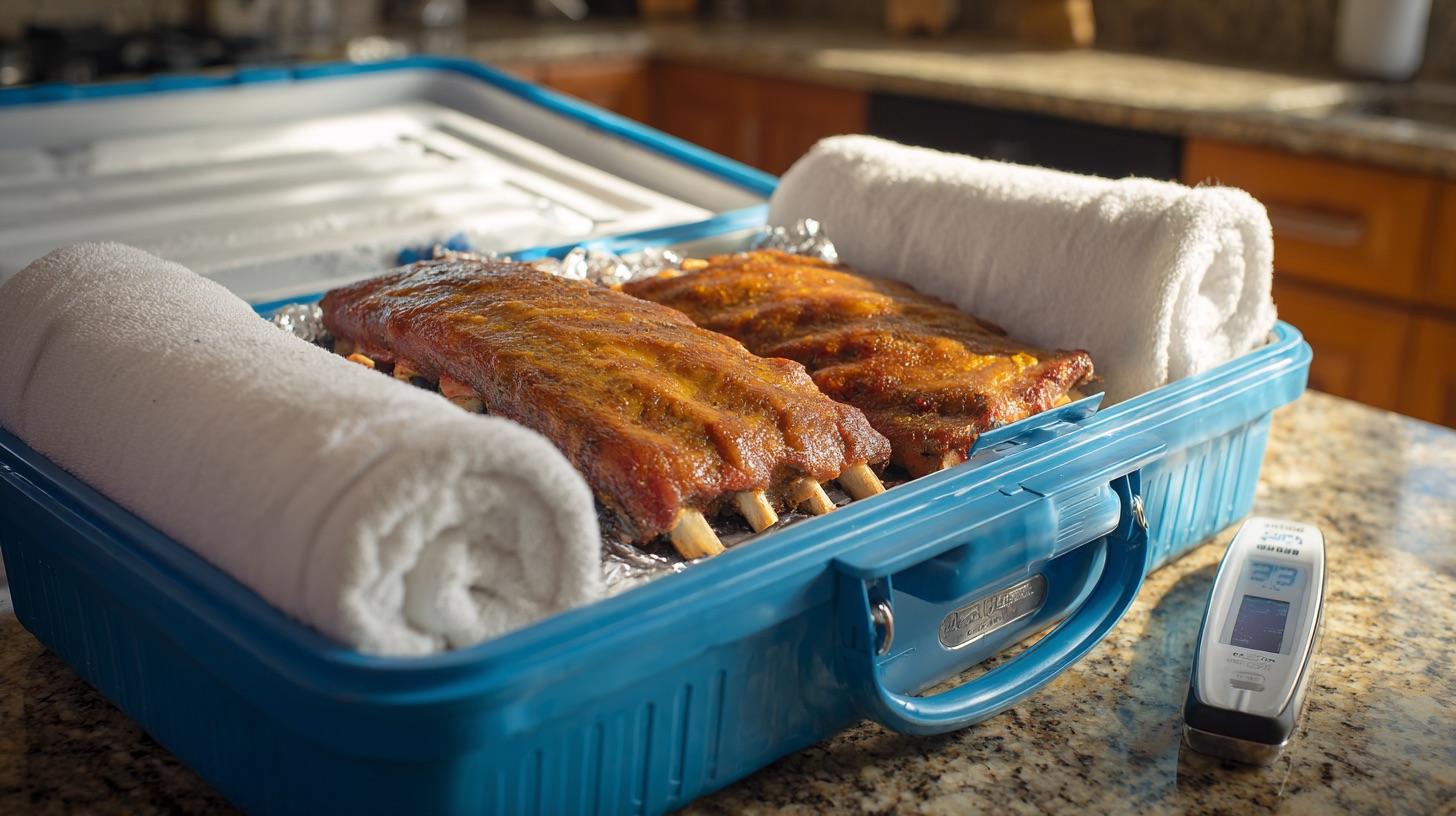
The ribs came off three hours before anyone is showing up. Or the game moved. Or you cooked Saturday for a Sunday party. Whatever the reason, you now need ribs to sit somewhere for hours and still be worth eating.
Good news: holding ribs is easy, and competition pitmasters do it on purpose. Ribs held properly are often better than ribs served straight off the smoker, because the rest lets the juices redistribute. What ruins them is holding them wrong.
The One Number That Matters: 140°F
Everything about holding cooked meat comes down to a single rule: keep it at or above 140°F (60°C), or get it below 40°F.
Between those two numbers is what the USDA calls the Danger Zone, where bacteria multiply fastest — doubling in as little as 20 minutes. Food left there for more than two hours should be thrown out, and no amount of reheating fixes it, because some bacteria leave behind toxins that survive cooking.
So “keeping ribs warm” isn’t really about warmth. It’s about staying above 140°F the entire time. A rack sitting on the counter under foil feels warm for an hour and is still sliding straight through the Danger Zone.
Buy a cheap instant-read thermometer and check the meat, not the air. It is the difference between confidently serving ribs four hours later and guessing.
Method 1: The Faux Cambro (Best for 2–4 Hours)
This is what most pitmasters actually do, and it needs nothing you don’t already own. A “cambro” is the insulated box caterers use; a cooler does the same job for free.
- Preheat the cooler. Fill it with hot tap water, close it, wait 10 minutes, then dump the water and dry it. Skipping this step is the single most common mistake — a cold cooler pulls heat out of your ribs instead of holding it in.
- Wrap the ribs. Double-wrap each rack in heavy-duty foil, or put them in a foil pan and seal the top tightly. Leave them whole; do not slice yet.
- Pack it tight. Put the wrapped racks in, then fill every gap with clean towels or crumpled newspaper. Air space is what kills a hold — the emptier the cooler, the faster it cools.
- Close it and leave it alone. Every time you open the lid you lose heat you can’t put back.
A properly preheated, tightly packed cooler will hold ribs above 140°F for 3 to 4 hours comfortably, and often longer. Check the meat temperature before serving rather than trusting the clock.
One caution: ribs continue cooking in there. If yours were already fall-off-the-bone tender, they’ll be mushy after four hours. Pull them slightly earlier than usual when you know you’re going to hold.
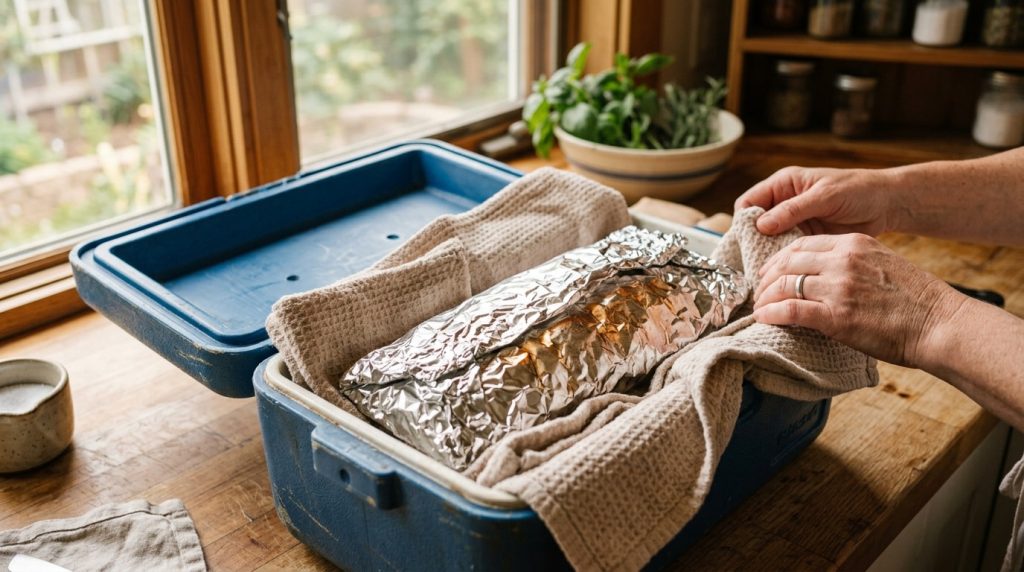
Method 2: The Oven (Best for Unlimited Time)
If your oven goes low enough, this is the most controllable option, and the only one that can hold safely all day.
- Set the oven to 150–170°F. Many ovens bottom out at 170°F, which is fine. If yours only goes to 200°F, use it but expect the ribs to keep cooking and dry out faster.
- Wrap the ribs in foil or cover a foil pan tightly. Uncovered ribs in a warm oven turn into jerky within the hour.
- Add a splash of liquid — apple juice, broth, even water — inside the wrap. It keeps the environment humid.
- Verify with a thermometer. Oven dials lie, sometimes by 25°F or more. Confirm the meat is holding above 140°F.
A “warm” or “proof” setting works too, as long as you confirm the actual temperature. If your oven’s lowest setting is 200°F and you need a long hold, crack the door slightly and check the meat after 30 minutes.
Method 3: Slow Cooker or Warming Drawer (Best for Serving)
A slow cooker on Warm holds around 165°F, safely above the line. The same trick carries a party-sized batch of pulled pork through a long afternoon. It’s awkward for whole racks, but excellent for rib tips, cut portions, or anything sauced.
Cut the ribs into two- or three-bone sections, add a little sauce or juice, and set to Warm — never Low, which will keep cooking them. Stir occasionally so the bottom pieces don’t scorch.
Warming drawers and chafing dishes with live fuel work on the same principle. Whatever you use, confirm it holds the meat above 140°F rather than assuming.
What Not to Do
| The tempting shortcut | Why it fails |
|---|---|
| Foil on the counter | Foil slows cooling; it doesn’t heat. Ribs cross into the Danger Zone within the hour. |
| Turned-off oven with the door shut | Feels warm, holds room temperature. Same problem, less obvious. |
| Cold cooler, no preheat | The insulation works both ways. A cold cooler drains heat fast. |
| Half-empty cooler | Air is the enemy. Unfilled space cools the meat in about half the time. |
| Slicing before holding | Every cut surface loses moisture. Hold whole, slice at serving. |
| Holding at 200°F+ | That’s cooking, not holding. Two hours later you have dry, over-rendered ribs. |
| Sauce on before a long hold | Sugar in the sauce keeps cooking and turns pasty. Sauce at the end. |
How Long Can You Actually Hold Ribs?
| Method | Realistic hold time | Quality after |
|---|---|---|
| Preheated cooler, packed tight | 3 to 4 hours, sometimes 6 | Excellent for the first 3 hours, softening after |
| Oven at 150–170°F, wrapped | As long as you like, safely | Good; gradually drier past 3 hours |
| Slow cooker on Warm | 2 to 3 hours | Good if sauced; edges can scorch |
| Foil on the counter | Under 2 hours, then discard | Not a holding method |
If your gap is longer than about six hours, stop trying to hold. Cool the ribs quickly, refrigerate them, and reheat before serving instead. That path gives you better ribs than a marathon hold ever will.
Holding for a Tailgate or a Drive
Transport is just holding with bumps in it, and the same rules apply with two additions.
- Preheat the cooler at home, where you have hot water. This is the step everyone skips in a hurry, and it’s the one that matters most.
- Keep the cooler in the cabin, not the trunk or the bed. A cold trunk in October pulls heat out fast, and a hot one in August is its own problem.
- Don’t open it to “check.” Take a thermometer reading when you arrive, not en route.
- Above 90°F outside, the counter rule tightens to one hour, so plan for the ribs to go straight from cooler to grill or serving.
If you’re driving more than a couple of hours, cold transport is safer and easier: chill the ribs fully, pack them with ice, and reheat at the destination.
The Short Version
- Above 140°F the whole time, or it isn’t holding, it’s spoiling.
- Preheat the cooler with hot water and pack out every air gap.
- Wrap tightly, hold whole, slice at serving.
- Sauce at the end, not before the hold.
- Check the meat with a thermometer, not the air or the clock.
- Over six hours? Chill and reheat instead.
Frequently Asked Questions
How long can you hold ribs in a cooler?
Three to four hours reliably in a preheated, tightly packed cooler, and often up to six. Confirm the meat is still above 140°F before serving rather than trusting the clock, since cooler size, insulation and how full it is all change the result.
What temperature should I hold cooked ribs at?
At or above 140°F. Below that you’re in the Danger Zone where bacteria multiply fastest. An oven set to 150–170°F is ideal; much above 200°F and you are cooking the ribs rather than holding them.
Can I keep ribs warm in the oven without drying them out?
Yes — wrap them in foil or cover the pan tightly, add a splash of apple juice or broth inside the wrap, and hold at 150–170°F. Uncovered ribs dry out fast even at low temperatures.
Do ribs keep cooking while being held?
Yes, slowly. Carryover cooking continues for a while in a cooler and indefinitely in a warm oven. If you know you’ll hold for several hours, pull the ribs a little before they hit your usual tenderness.
Is it safe to keep ribs warm overnight?
Only in an appliance that genuinely holds above 140°F all night and that you can verify with a thermometer. A cooler will not do this. For an overnight gap, chill the ribs promptly and reheat the next day instead.
Should I sauce ribs before or after holding?
After. Sugar in barbecue sauce keeps cooking during a long hold and turns sticky and pasty. Hold them plain and sauce in the last few minutes before serving, on the grill or under the broiler if you want the glaze to set.
Related Guides
- What temp are ribs done? — pull them right before you hold them.
- How to reheat ribs — for gaps longer than six hours.
- Ribs left out overnight? — what happens when a hold goes wrong.
- How to tell if ribs are bad — the checks that matter before and after.