
You pulled the brisket probe-tender, gave it fifteen minutes because the meat was hot, and then the board flooded the moment the knife went in. Twelve hours of fire management, and the juice ended up on the cutting board. Resting is the cheapest step in the whole cook and the one most often cut short.
The 60-Second Answer
Rest a whole brisket for at least one hour, loosely tented, before slicing. Two to four hours wrapped in a preheated cooler is better and is what most competition cooks do. The one rule you cannot bend: keep it above 140°F the whole time, because 40°F to 140°F is the range USDA calls the danger zone, where bacteria multiply fastest.
Resting and Holding Are Two Different Jobs
Resting is letting a just-finished brisket come down from its peak so the muscle stops squeezing and reabsorbs the juice sitting in it. That takes an hour or so and it happens whether you plan it or not.
Holding is keeping an already-rested brisket serve-ready for hours because dinner is at six and the brisket finished at one. Holding is a food-safety exercise first and a texture exercise second.
The confusion costs people brisket. A cook who “rests” for four hours on the counter has actually held it, badly, through the danger zone. A cook who slices after twenty minutes never rested it at all.
What the Rest Is Actually Doing
Muscle fibers contract as they heat and press moisture out toward the surface. Cut into that immediately and the pressure releases onto the board. As the brisket cools toward the 150s and 160s, the fibers relax and that moisture redistributes through the meat instead of running out of it.
A large brisket also keeps cooking for a while after it leaves the smoker. A few degrees of carryover is normal, which is another reason to pull on feel at the lower end of the tender window rather than chasing a number, as covered in what temp brisket is done.
The 140°F Line
USDA guidance is specific: hot food must be held at 140°F or above, and food should not sit out of refrigeration for more than two hours (one hour if the room is above 90°F). A brisket wrapped in paper and left on the counter from one o’clock until six has spent most of that afternoon sliding through the danger zone.
So the practical rule for any rest longer than about an hour is simple: put a thermometer in it and keep the number above 140°F. A preheated cooler does this easily for four hours or more.
| Length of rest | Where | What you get |
|---|---|---|
| 15–30 min | Counter, tented | Not enough. The board still floods. |
| 1 hour | Counter, loosely tented | The practical minimum; juice stays in the slices |
| 2–4 hours | Preheated cooler, wrapped | The sweet spot; stays above 140°F, texture improves |
| 5–8 hours | Holding cabinet at 150–160°F | Safe, but the flat starts going soft and pot-roasty |
| Any length below 140°F | Counter or cold cooler | Danger zone. Unsafe to serve however good it looks |
The Faux Cambro, Step by Step
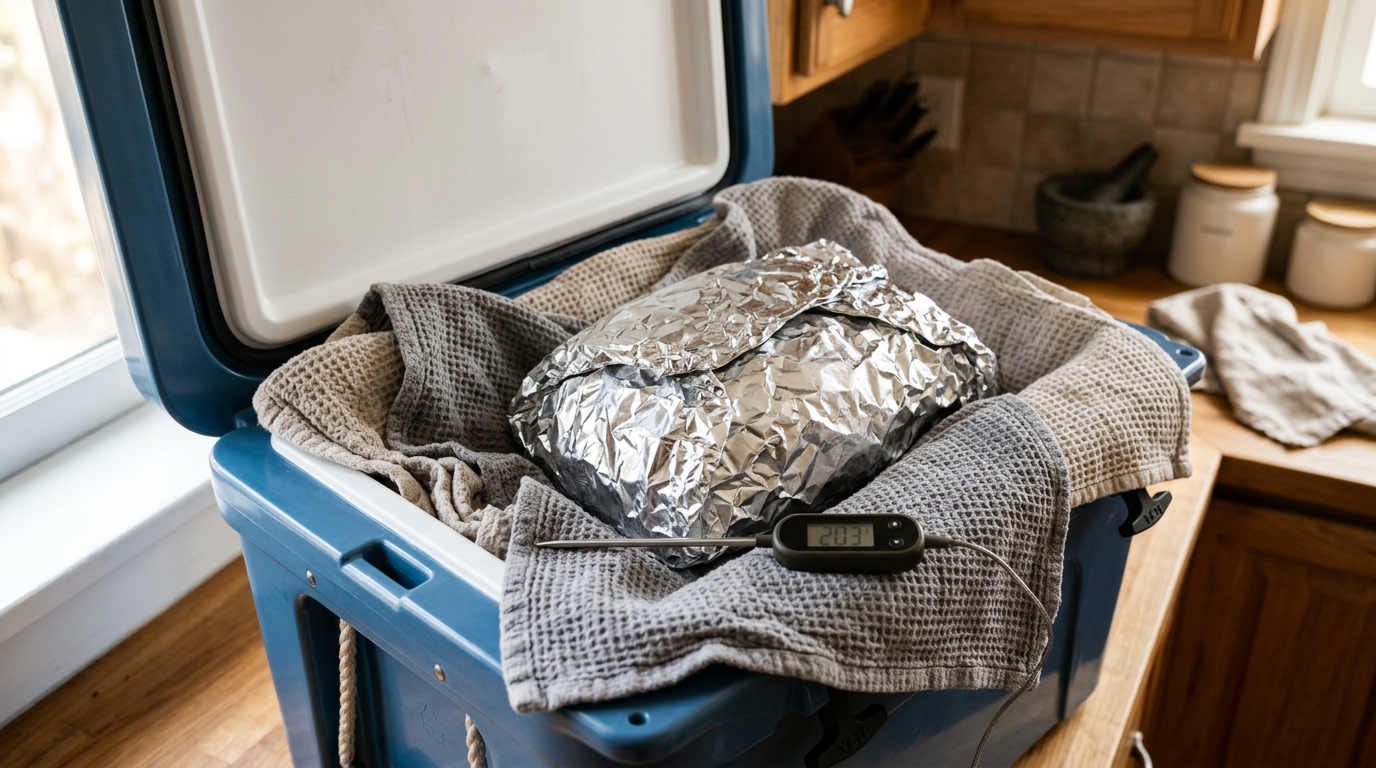
Commercial kitchens hold food in a Cambro warming box. A hard-sided cooler does the same thing for one afternoon.
- Fill the cooler with hot tap water, close it, and leave it ten minutes. A cold cooler steals heat from the brisket; a preheated one does not.
- Pour the water out and dry the inside quickly.
- Line the bottom with a towel, put the wrapped brisket in fat side up, pack towels around and over it so there is no big air gap.
- Close the lid and leave it shut. Every peek costs you heat.
- Put a leave-in probe through the towels if you have one. You are watching for 140°F, not for a target.
Loaded this way, a whole packer stays above 140°F for four to six hours and is often still too hot to handle bare-handed at hour three. The same method holds ribs and pork shoulder, described in how to keep barbecue warm after cooking.
Bark, Steam and the Vent
A brisket wrapped in foil keeps steaming inside the wrap, which softens bark. If bark matters to you, open the wrap for the first ten minutes of the rest to let the steam escape, then close it loosely and go into the cooler. Butcher paper breathes enough that this matters less.
When a Long Rest Goes Wrong
Two failure modes. The first is temperature: the brisket coasts under 140°F for hours because the cooler was cold or the lid kept opening. The second is texture: past roughly six hours the flat can turn soft and stringy, closer to pot roast than barbecue. If you need to bridge a longer gap than that, it is better to chill the brisket properly and reheat it to 165°F than to hold it warm all day. How to reheat brisket covers the wrap, the liquid and the bark.
Slicing After the Rest
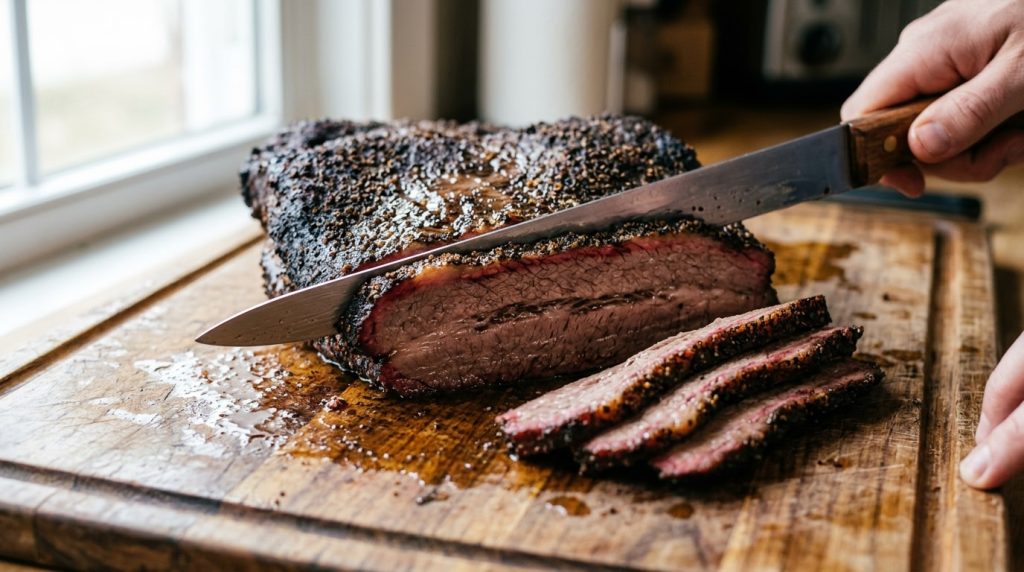
Separate the point from the flat first, then slice each against its own grain. The grain runs in different directions in the two muscles, which is why a single straight cut through a whole packer gives you tender slices on one end and chewy ones on the other. Pencil-thick for the flat, a little thicker for the point.
The Bottom Line
One hour is the minimum rest, two to four hours in a preheated cooler is better, and above 140°F is not negotiable. Vent the wrap briefly if you want the bark back, and if the schedule has slipped by more than six hours, chill it and reheat to 165°F instead of holding it warm.
Frequently Asked Questions
Can I rest brisket too long?
Yes, in two ways. Below 140°F you have a safety problem. Above about six hours, even held safely, the flat softens and loses the sliceable texture you cooked it for.
Should I rest brisket in the oven instead?
That works if your oven holds a true 150°F to 170°F. Many home ovens will not go that low and their lowest setting runs 200°F or hotter, which keeps cooking the brisket instead of holding it.
Do I unwrap the brisket to rest it?
Leave it wrapped for the hold, but vent it for the first ten minutes if you want to save the bark. Unwrapping it completely for hours dries the surface and drops the temperature fast.
What if the brisket fell below 140°F while resting?
If it happened within two hours, reheat it to 165°F and serve. Longer than that, and USDA guidance says to discard it rather than gamble.
Related Guides
- How Long to Smoke Prime Rib (and When to Pull It)
- What Temp Is Brisket Done? Safe vs Probe-Tender
- How to Keep Barbecue Warm After Cooking
- Smoked Brisket Recipe (Aaron Franklin Method)
- How to Tell if Brisket Is Bad
Never Throw Out Good Meat Again
Get the one-page BBQ cheat sheet: fridge and freezer times for every cut, safe temperatures, and the spoilage signs that are false alarms. Free, no spam.
No spam, and you can unsubscribe any time.