
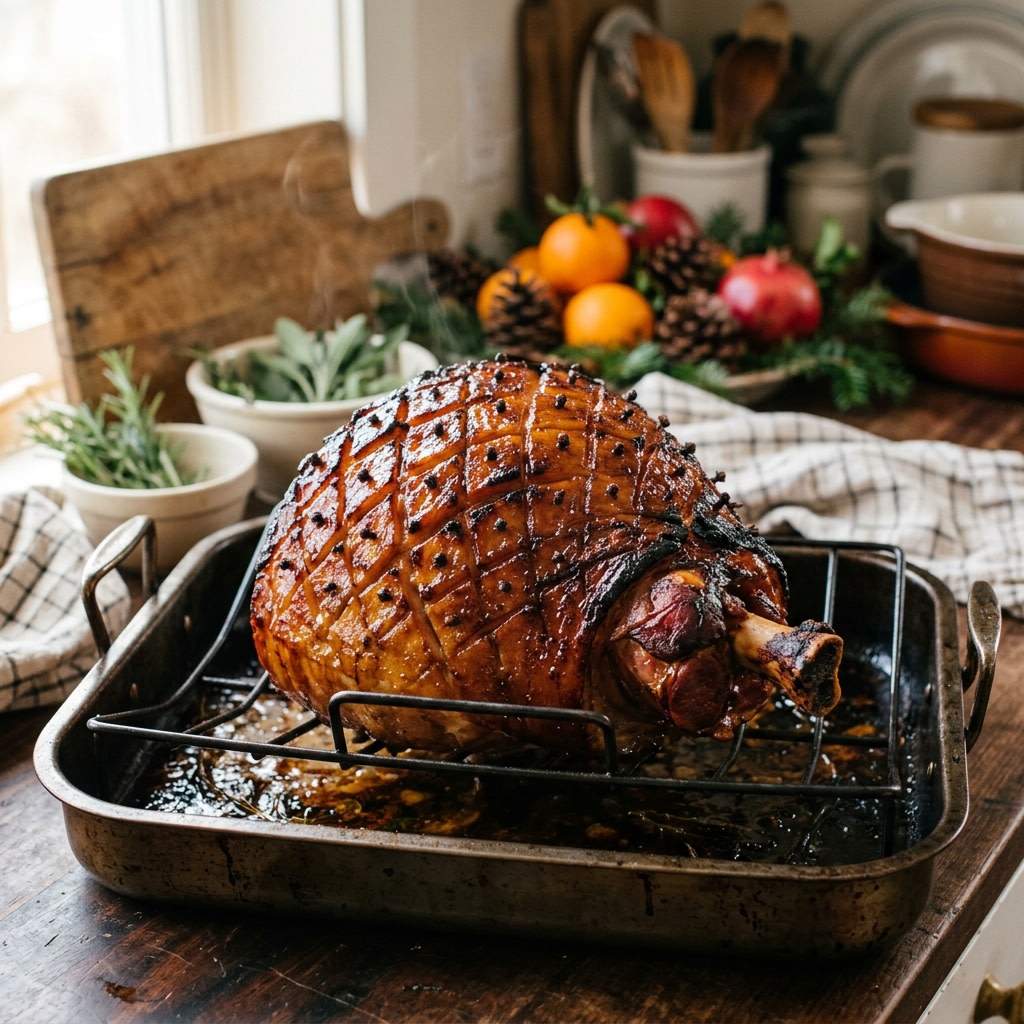
The holiday ham is going into the oven, the label says “fully cooked,” and you want to know what the thermometer should read before you carve. The answer depends on which ham you bought and where it was packaged. FSIS uses three different targets for ham, and picking the wrong one means either drying out a ham that only needed warming or serving one that was still raw.
The 60-Second Answer
- 140°F: fully cooked ham packaged in a USDA-inspected plant, reheated.
- 165°F: leftovers, and cooked ham repackaged anywhere else.
- 145°F, then rest at least 3 minutes: fresh (raw) ham and ham labelled “cook before eating”.
FSIS bases its timetable on an oven set to 325°F. These are safety minimums; you can take a ham higher if you prefer it hotter.
Which number applies to your ham
| Your ham | Label words | Safe internal temperature |
|---|---|---|
| Whole, half or spiral-cut ham, still in the plant’s packaging | “Fully cooked” or “cooked” | 140°F |
| Cooked ham repackaged at the store, or leftovers from your own dinner | “Cooked”, or no plant label | 165°F |
| Cured or smoked ham that still needs cooking | “Cook before eating” | 145°F + 3-minute rest |
| Raw pork leg with no cure | “Fresh” or “uncured” | 145°F + 3-minute rest |
The 140°F target is for warming. A fully cooked ham can be eaten straight from the package, so the oven only needs to bring it up to serving temperature. The 145°F target is for cooking raw meat, the same as other pork roasts in our pork temperature guide.
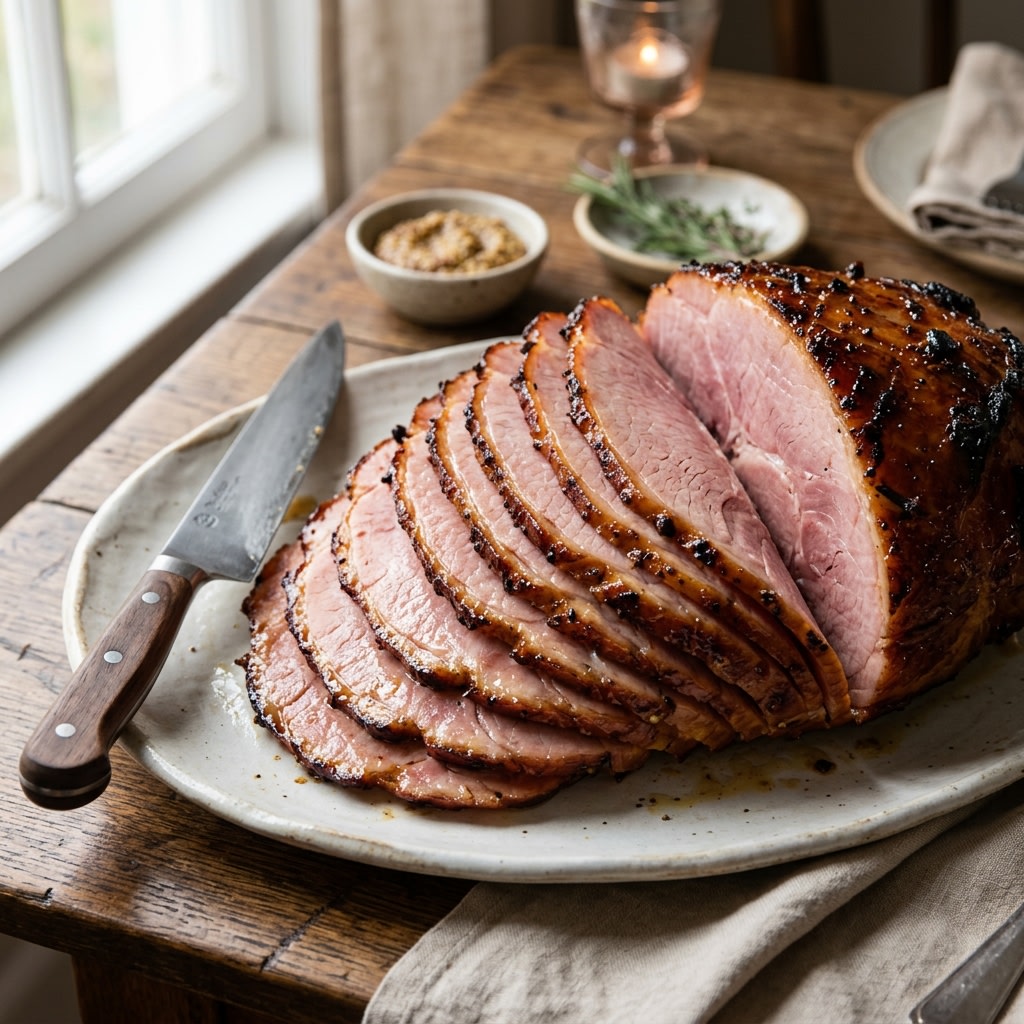
Oven times at 325°F: the FSIS timetable
Use these minutes per pound to plan when dinner is ready. They are estimates; the thermometer decides when the ham is done.
| Ham | Cut and weight | Minutes per pound | Target |
|---|---|---|---|
| Smoked, cook before eating | Whole, bone-in, 10–14 lb | 18–20 | 145°F |
| Smoked, cook before eating | Half, bone-in, 5–7 lb | 22–25 | 145°F |
| Smoked, cook before eating | Shank or butt portion, 3–4 lb | 35–40 | 145°F |
| Smoked, cook before eating | Arm picnic shoulder, boneless, 5–8 lb | 30–35 | 145°F |
| Smoked, cook before eating | Shoulder roll, boneless, 2–4 lb | 35–40 | 145°F |
| Smoked, fully cooked (reheat) | Whole, bone-in, 10–14 lb | 15–18 | 140°F |
| Smoked, fully cooked (reheat) | Half, bone-in, 5–7 lb | 18–24 | 140°F |
| Smoked, fully cooked (reheat) | Arm picnic shoulder, boneless, 5–8 lb | 25–30 | 140°F |
| Smoked, fully cooked (reheat) | Canned, boneless, 3–10 lb | 15–20 | 140°F |
| Smoked, fully cooked (reheat) | Vacuum packed, boneless, 6–12 lb | 10–15 | 140°F |
| Smoked, fully cooked (reheat) | Spiral cut, whole or half, 7–9 lb | 10–18 | 140°F |
| Fresh, uncooked | Whole leg, bone-in, 12–16 lb | 22–26 | 145°F |
| Fresh, uncooked | Whole leg, boneless, 10–14 lb | 24–28 | 145°F |
| Fresh, uncooked | Half, bone-in, 5–8 lb | 35–40 | 145°F |
The 140°F targets assume the ham is in its USDA-inspected plant packaging. A cooked ham repackaged elsewhere goes to 165°F.
Worked example: timing a holiday ham
Say you bought a 12 lb fully cooked, bone-in whole ham. At 15 to 18 minutes per pound, the estimate is 180 to 216 minutes, or about 3 to 3.6 hours at 325°F. Start checking the temperature at the 3-hour mark and pull it when the thickest part reads 140°F.
An 8 lb spiral-cut ham at 10 to 18 minutes per pound works out to 80 to 144 minutes, roughly 1 hour 20 minutes to 2 hours 24 minutes. Begin checking at the low end, because the pre-sliced meat can dry out if it overshoots.
A 14 lb fresh, bone-in leg is a bigger job: 22 to 26 minutes per pound gives 308 to 364 minutes, about 5 hours 8 minutes to 6 hours 4 minutes. It needs 145°F and a rest of at least 3 minutes before carving. In every case, these are estimates and the thermometer reading wins. If you want to cook the ham outdoors, see how to smoke a ham.
Where to put the thermometer
Push the probe into the thickest part of the ham, away from the bone. A probe touching bone gives a misleading reading. On a spiral-cut ham, slide it in from the side, into the meat between slices near the centre, and check a second spot before you call it done.
Do not go by colour. FSIS says colour is not a reliable sign of doneness. Cured ham stays pink however long you heat it, and fresh ham turns greyish white when cooked, so neither tells you the temperature.
Common mistakes with ham temperatures
- Taking leftovers only to 140°F. Once a ham has been served, reheat the leftovers to 165°F.
- Skipping the rest on fresh ham. The 145°F target for raw and cook-before-eating ham includes at least 3 minutes of rest.
- Letting the buffet ham cool off. Hold hot ham at 140°F or above, and refrigerate it within 2 hours of serving, or 1 hour above 90°F. Our guide to how long ham lasts covers what happens next.
- Reheating a ham that sat out too long. Some bacteria make toxins that cooking does not destroy. If you are unsure, check how to tell if ham is bad.
The Bottom Line
Read the label, then pick the number: 140°F for fully cooked ham from a USDA-inspected plant, 165°F for leftovers and repackaged ham, and 145°F plus a 3-minute rest for fresh or cook-before-eating ham. Set the oven to 325°F, use the timetable to plan, and let the thermometer in the thickest part decide.
Frequently Asked Questions
What temperature should a fully cooked ham reach?
FSIS says to reheat a cooked ham packaged in a USDA-inspected plant to 140°F. If it was repackaged elsewhere, or it is a leftover, take it to 165°F.
Do I need to rest a ham?
Fresh ham and cook-before-eating ham need at least 3 minutes of rest after reaching 145°F. A fully cooked ham you are reheating has no required rest.
How long does a spiral ham take at 325°F?
FSIS lists 10 to 18 minutes per pound for a 7 to 9 lb spiral-cut ham. Check the temperature early and stop at 140°F.
Can I eat fully cooked ham cold?
Yes. FSIS says fully cooked ham can be eaten straight from the package. Reheating is for serving it warm.
Related Guides
Never Throw Out Good Meat Again
Get the one-page BBQ cheat sheet: fridge and freezer times for every cut, safe temperatures, and the spoilage signs that are false alarms. Free, no spam.
No spam, and you can unsubscribe any time.