
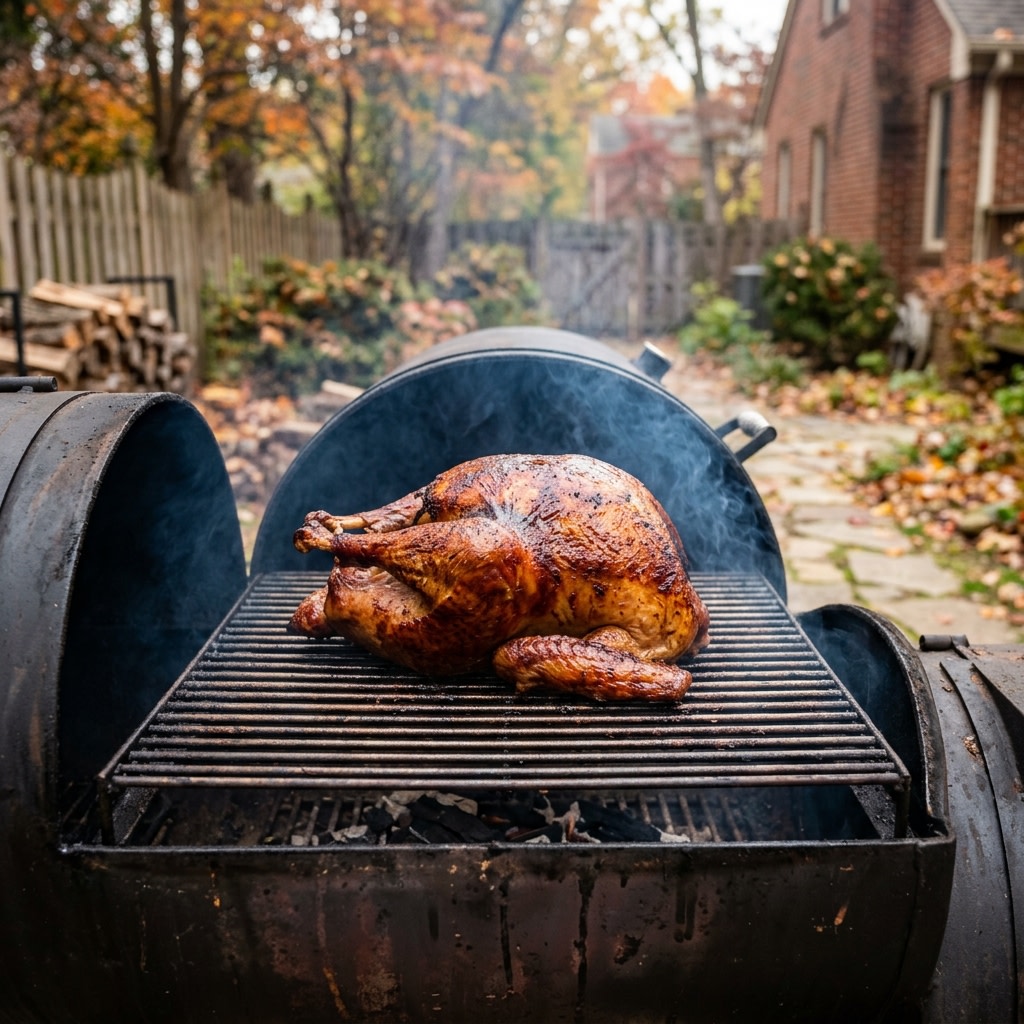
You have a turkey, a smoker and a dinner time that will not move. The question is when to put the bird on so it is done when people sit down, and the honest answer is a range. FSIS gives a per-pound estimate for smoking poultry, and the temperature you run the smoker at decides whether you land near the short end or the long end.
The 60-Second Answer
FSIS says to keep the smoker between 225°F and 300°F and to estimate 20 to 30 minutes per pound. A 12 lb turkey works out to roughly 4 to 6 hours. It is done when a food thermometer reads 165°F in the innermost part of the thigh, the wing and the thickest part of the breast. Thaw the bird completely first and never stuff a turkey you are smoking.
Estimated Smoking Times by Turkey Size
These times come from multiplying each weight by the FSIS range of 20 to 30 minutes per pound. The thaw column uses the FSIS fridge guideline of about 24 hours for every 4 to 5 pounds, rounded. Both are estimates for planning. The thermometer decides when the turkey is done.
| Turkey weight | Estimated smoke time (20–30 min/lb) | Fridge thaw before smoking |
|---|---|---|
| 8 lb | 2 hr 40 min–4 hr | About 1.5–2 days |
| 10 lb | 3 hr 20 min–5 hr | About 2–2.5 days |
| 12 lb | 4–6 hr | About 2.5–3 days |
| 14 lb | 4 hr 40 min–7 hr | About 3–3.5 days |
For a bird between sizes, do the same sum. A 13 lb turkey at 20 minutes per pound is 260 minutes, and at 30 minutes it is 390, so roughly 4 hours 20 minutes to 6 hours 30 minutes. Plan your start time from the long end. A turkey that finishes early can be held hot at 140°F or above while you wait; one that finishes late holds up dinner.
Low End or High End of the Range?
Where your smoker sits inside 225°F to 300°F is the biggest reason two turkeys of the same weight finish hours apart. Near 225°F the cook runs long, toward 30 minutes a pound, and the bird spends more time taking on smoke. The trade is the skin. At the low end the fat under the skin does not render well, so the skin tends to come out soft and rubbery.
Toward 300°F the cook moves toward the 20-minute end, and the extra heat renders that fat and crisps the skin. You still get a smoky bird, with a lighter smoke flavour. If crisp skin matters to you, run the smoker near the top of the FSIS range. If you want the most smoke and do not mind softer skin, run it lower and allow the full time. Either way, the turkey stays inside the safe smoker range and the finish line is the same 165°F.
Thaw Completely and Leave the Cavity Empty
Every time in the table assumes a fully thawed turkey. A bird that is still icy in the middle cooks unevenly: the breast heats through while the inner thigh lags, and the per-pound estimate stops meaning anything. Start the fridge thaw early, at about 24 hours per 4 to 5 pounds. If you run short, FSIS also allows cold water in a sealed bag with the water changed every 30 minutes, and our turkey thawing and storage guide walks through both methods.
FSIS is clear that you should not stuff a turkey you smoke. Stuffing packed into the cavity heats slowly at smoker temperatures and can sit in the 40°F to 140°F danger zone for a long time, where bacteria can double in as little as 20 minutes. Bake the stuffing separately.
Spatchcocking Shortens the Cook
Removing the backbone and pressing the turkey flat shortens the cook. A flat turkey has no hollow middle to heat, the thighs sit out where the heat reaches them, and the breast and legs finish closer together. The cook is shorter and more even than a whole bird of the same weight, and the skin is all on top where it can crisp. Use the table as an upper limit and start checking the temperature early. Our spatchcock turkey method covers the cut and the setup.
Common Timing Mistakes
Planning from the short end of the range is the usual one, and it leaves you watching a stalled thermometer while guests wait. Checking only the breast is another; the inner thigh is often the last spot to reach 165°F. Opening the lid often lets heat out and pushes the cook longer. Judging by colour is the last: smoked turkey can look pink near the surface, and FSIS says colour on its own is not a reliable sign of doneness. For probe placement and texture targets, see what temp smoked turkey is done.
The Bottom Line
Run the smoker between 225°F and 300°F and plan on 20 to 30 minutes per pound, using the long end for your start time. Higher in that range means a shorter cook and crisper skin. Thaw the bird fully, cook the stuffing separately, and pull the turkey when the thigh, wing and breast all read 165°F.
Frequently Asked Questions
How long does a 12 lb turkey take to smoke?
At the FSIS estimate of 20 to 30 minutes per pound, about 4 to 6 hours. Run the smoker hotter for the shorter time, and check with a thermometer.
Can I smoke a turkey that is still partly frozen?
FSIS says to thaw it completely first. A frozen centre throws off every time estimate and leaves the inner thigh lagging behind the breast.
How long do smoked turkey leftovers keep?
Refrigerate them in shallow containers within 2 hours and use them within 3 to 4 days, or freeze them for 2 to 6 months for best quality. If you are unsure about older leftovers, see how to tell if turkey is bad.
Why is my turkey taking longer than the chart says?
A low smoker temperature, a lid opened often, or a bird that was not fully thawed are the usual causes. Keep the smoker inside 225°F to 300°F and wait for 165°F.
Related Guides
- What Temp Is Smoked Turkey Done?
- Matt Pittman-Inspired Spatchcock Turkey
- Turkey Food Safety: Thawing and Storage
- How to Tell If Turkey Is Bad
Never Throw Out Good Meat Again
Get the one-page BBQ cheat sheet: fridge and freezer times for every cut, safe temperatures, and the spoilage signs that are false alarms. Free, no spam.
No spam, and you can unsubscribe any time.