
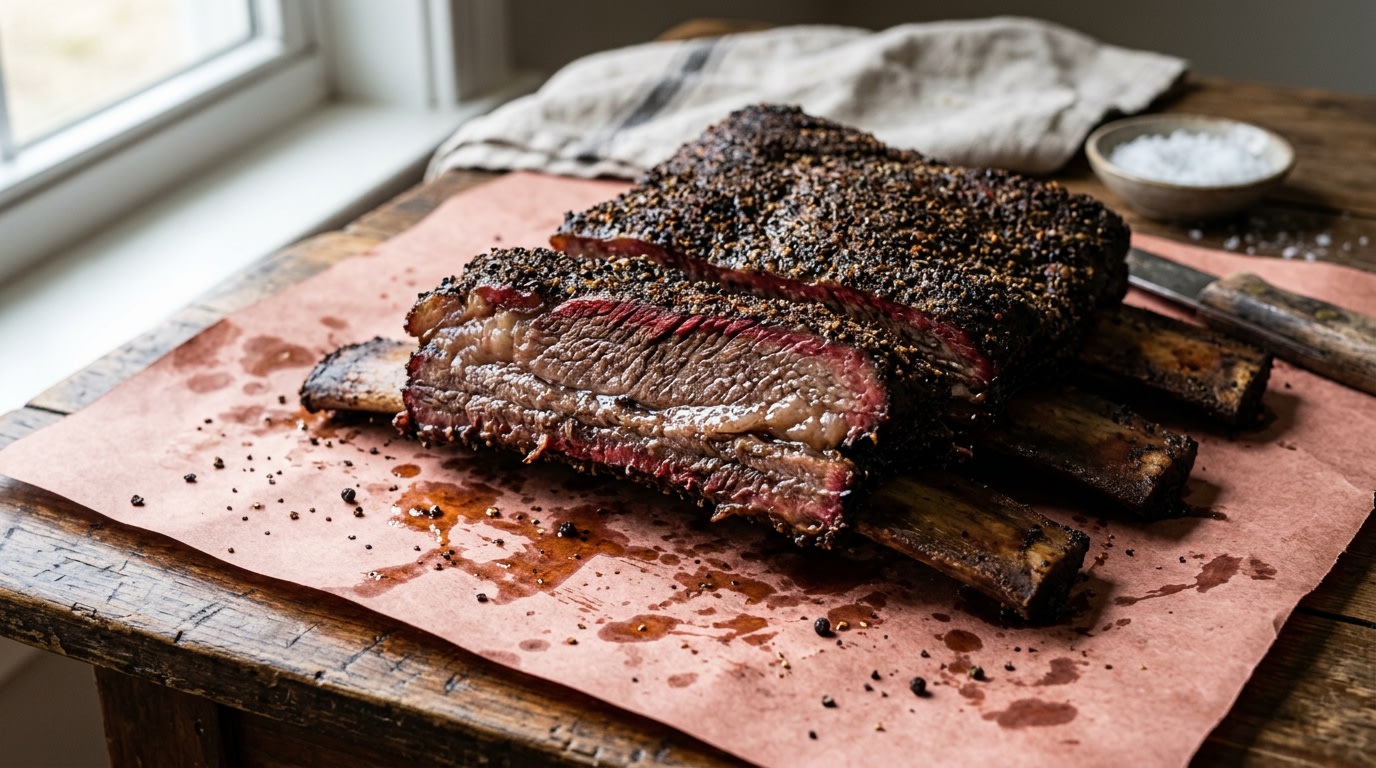
Beef ribs come off the smoker at the temperature that would ruin a steak. People who cook them like a steak get something closer to a chew toy, and people who cook them like brisket usually get it right. The number is high, and the way you confirm it is not the thermometer.
The 60-Second Answer
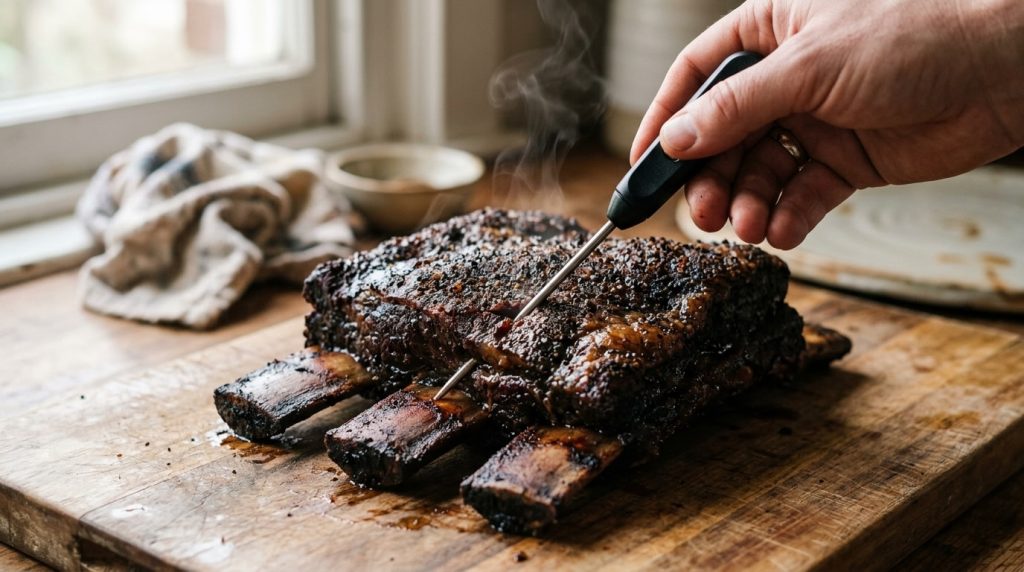
Whole-muscle beef is safe at 145°F with a 3-minute rest, per USDA. Beef ribs only become tender between roughly 203°F and 210°F, higher than brisket, because the meat between the bones is loaded with connective tissue. Probe the thickest meat between two bones: when it feels like the probe is going into softened butter, they are done.
Know Which Beef Rib You Bought
Three different cuts get sold as beef ribs, and they do not finish at the same point.
| Cut | What it is | Usual finish |
|---|---|---|
| Plate short ribs (the “dino” ribs) | Three huge bones, a thick meat cap | 203–208°F, 7–9 hours at 250°F |
| Chuck short ribs | Shorter bones, meat between and over them | 203–207°F, 5–7 hours |
| Back ribs | What is left after the ribeye is cut off; little meat on top, more between bones | 198–205°F, 4–5 hours |
Back ribs fool people because they look like a pork rack and cook faster, so they get pulled at 190°F and come out tough between the bones.
Where to Probe
Go into the thickest meat between two bones, not through the cap and not alongside a bone. Bone reads several degrees hotter than the meat next to it, so a probe touching one tells you the ribs are ready before they are.
Take two or three readings on a plate rack, because the bones sit at different depths. If one spot says 199°F and another 206°F, work with the lower number and keep cooking.
The Feel Test Is the Real One
Above 200°F the temperature stops being informative and the resistance takes over. A finished beef rib takes the probe with no push-back at all, like room-temperature butter. Two more signs, both worth checking:
- The jiggle. Lift one end of the rack with tongs and it should wobble like set gelatin rather than staying rigid.
- Bone pull-back. An inch or so of bone exposed at the ends is normal on a finished rack.
Meat that falls off the bone has gone too far, the same way it has on pork ribs. You want it to release cleanly when bitten, not collapse on the board.
The Stall and the Wrap
Beef ribs stall between 150°F and 170°F for the same reason brisket does: moisture evaporating from the surface takes heat away as fast as the smoker adds it. Wrapping in butcher paper after the bark has set shortens it; going unwrapped gives a heavier bark and adds an hour or two. Neither changes the finish temperature, only how long it takes to get there.
Whatever you do, do not answer the stall by running the pit at 325°F. The fat cap renders unevenly at that speed and the meat between the bones dries before the collagen has softened. The full explanation of the stall is in what temp brisket is done.
Rest, but Not for as Long as Brisket
Thirty minutes to an hour, loosely tented or in vented paper, is enough. Beef ribs are smaller than a packer brisket and lose heat faster, so a long cooler hold turns the bark soft with little benefit. Keep them above 140°F if the rest runs longer than an hour, since 40°F to 140°F is the range USDA calls the danger zone. The cooler method is in how long to rest brisket.
Storage and Reheating
Cooked beef ribs keep 3 to 4 days in the refrigerator and 2 to 3 months in the freezer for best quality. Reheat to 165°F, wrapped with a splash of liquid at 250°F so the meat steams instead of drying; the same method as reheating pulled pork. If you are unsure whether beef in the fridge is still good, the checks are in how to tell if beef ribs are bad.
The Bottom Line
145°F is the safety floor and 203°F to 210°F is where beef ribs get tender. Probe the thick meat between bones, confirm with the jiggle and a probe that meets no resistance, rest 30 to 60 minutes above 140°F, and reheat leftovers to 165°F.
Frequently Asked Questions
Are beef ribs done at 195°F?
Rarely. Brisket often finishes around 200°F; beef ribs usually need a few degrees more before the connective tissue between the bones gives up. Start testing at 200°F and expect 203°F to 208°F.
Why are my beef ribs tough at 205°F?
Either the probe was touching bone, or the cook ran hot and fast. Re-probe in three fresh spots between bones; if the reading holds and the meat still fights the probe, give it another 30 minutes at 250°F.
Should beef ribs fall off the bone?
No. That is overcooked. A finished rib holds together when lifted and releases cleanly where you bite it.
Do I need to remove the membrane?
On back ribs, yes, the same as pork. On plate ribs many cooks leave it because the bones are so large that the membrane holds the rack together during a long cook.
Related Guides
- What Temp Is Brisket Done? Safe vs Probe-Tender
- What Temp Are Ribs Done? Safe vs Tender Explained
- How to Tell if Beef Ribs Are Bad
- How Long to Rest Brisket
Never Throw Out Good Meat Again
Get the one-page BBQ cheat sheet: fridge and freezer times for every cut, safe temperatures, and the spoilage signs that are false alarms. Free, no spam.
No spam, and you can unsubscribe any time.