
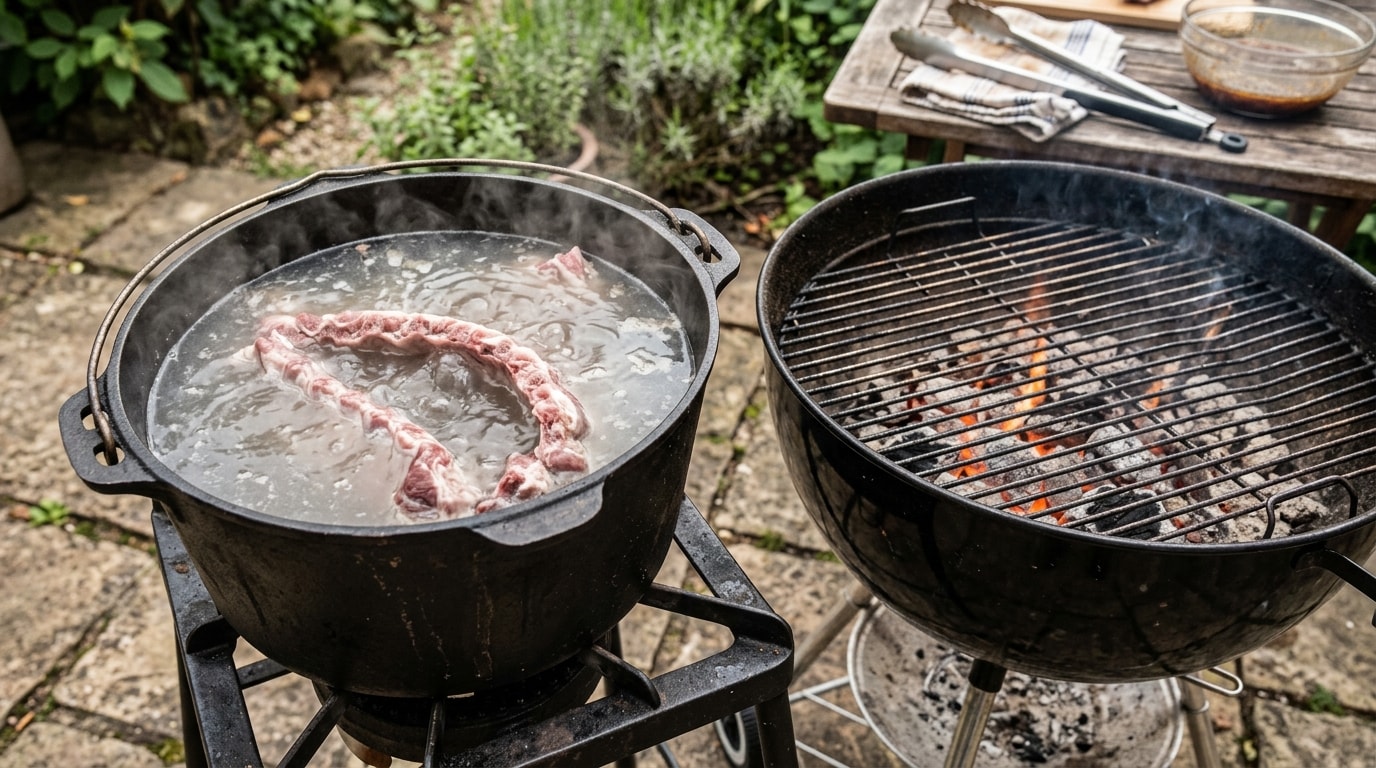
Boiling ribs before they hit the grill is a habit in a lot of kitchens. It promises tender meat and a short grill session, and it does shorten the time over the fire. The trouble is what happens to the flavour in that pot, and the fact that there are easier ways to get the same head start. Here is when precooking makes sense, the FSIS rule that comes with it, and the methods that work better than a pot of plain water.
The 60-Second Answer
You can boil ribs first, and FSIS says partial precooking is a good way to cut grilling time, as long as the ribs go immediately onto a preheated grill to finish. Simmering in plain water pulls flavour out of the meat and into water you pour away, though. Better options: braise them covered with a liquid (FSIS: 1½ to 2 hours for 2 to 4 pounds), roast them at 350°F for the same time or until fork tender, or cook them the whole way on the grill over indirect heat.
Why People Boil Ribs
The appeal is real. Ribs are a less tender meat, full of connective tissue that needs time and moist heat to soften. A pot of water on the stove gets that started without tending a fire, and the grill only has to warm the ribs through and add some char and sauce.
FSIS backs the general idea. Precooking food partially in the microwave, oven or on the stove is, in its words, a good way of reducing grilling time. So boiling is safe when it is done right. The question is whether it gives you the best ribs.

What Boiling Costs You
Meat in a large pot of plain water gives up some of its juices and soluble flavour into that water. That is how stock gets its taste. When you drain the pot, that flavour goes down the sink with it.
Boiled ribs also come out of the water wet and pale, so a rub has less to cling to, and the surface needs time on the grill to dry before it browns. A hard boil can push the meat past tender into stringy before it ever sees the fire. None of this makes boiled ribs unsafe. It makes them blander than they could be.
Braising keeps most of what boiling loses. The ribs sit in a smaller amount of flavoured liquid under a cover, and whatever comes out of the meat stays in that liquid, which you can reduce into a glaze.
Precooking Methods Compared
FSIS times below are its approximate times for cooking 2 to 4 pounds of ribs by that method alone. Plain boiling has no FSIS time.
| Method | How it works | FSIS time (2–4 lb ribs) | What you get |
|---|---|---|---|
| Boil in plain water | Ribs submerged, water drained | No FSIS time | Soft, but flavour lost to the water; wet surface |
| Braise | Covered, simmered with a liquid | 1½–2 hours | Tender and moist; the liquid becomes sauce |
| Oven first at 350°F | Shallow pan, uncovered | 1½–2 hours, or until fork tender | Drier surface that browns fast on the grill |
| All on the grill, indirect heat | Ribs beside the fire, lid closed | 1½–2 hours | One step, smoke and char, no transfer |
For the oven route in detail, including lower temperatures, see how long to cook ribs in the oven.
The FSIS Rule for Precooked Ribs
This part is not optional. FSIS says precooked food must go immediately onto the preheated grill to finish cooking. It also says never to partially grill meat and finish cooking it later.
Half-cooked ribs that sit on the counter, or go into the fridge overnight, have been warmed through the danger zone of 40–140°F without being fully cooked. So light the grill before the ribs come out of the pot or oven, and move them straight across.
If you want to get ahead, cook the ribs completely, refrigerate them within 2 hours, and reheat them later to 165°F as leftovers. How to reheat ribs walks through that.
Grilling Ribs Indirect From Start to Finish
The simplest option skips the pot. Set up a two-zone fire, put the ribs on the side away from the coals or lit burners, and close the lid. FSIS lists 1½ to 2 hours for 2 to 4 pounds of ribs this way. Smoking is the slower version: FSIS keeps the air between 225 and 300°F, and notes that less tender meats benefit from it.
Either way, the clock is a guide. USDA’s safe minimum for pork is 145°F with a 3-minute rest, but ribs stay tough there. This site’s texture target is 195–203°F between the bones; see what temp ribs are done. Lift the rack with tongs about a third of the way along: done ribs bow deeply and crack on the surface. Sauce in the last stretch so it does not burn. If yours still come out chewy, why are my ribs tough covers the usual causes.
The Bottom Line
Boiling ribs before grilling is safe if they go straight onto a preheated grill, but plain water carries flavour away. Braising, a 350°F oven, or cooking the whole way over indirect heat all get the ribs tender while keeping their flavour. Whatever you choose, never stop partway and finish later, and let the thermometer and the bend test call it.
Frequently Asked Questions
Does boiling ribs make them more tender?
It softens them, because moist heat breaks down connective tissue. Braising does the same job in a smaller amount of liquid that keeps the flavour.
Can I boil ribs the day before grilling?
Not partway. FSIS says never to partially cook meat and finish it later. Cook them fully, refrigerate them within 2 hours, and reheat them to 165°F.
How long should I braise ribs before grilling?
FSIS lists braising 2 to 4 pounds of ribs for 1½ to 2 hours. Move them straight to the preheated grill afterward to finish and glaze.
Are boiled ribs safe to eat?
Yes, once they reach USDA’s safe minimum of 145°F with a 3-minute rest. For tender ribs, cook them toward the 195–203°F texture target.
Related Guides
- What Temp Are Ribs Done? Safe vs Tender Explained
- How Long to Cook Ribs in the Oven at 350°F (and Lower)
- Why Are My Ribs Tough? 5 Causes and the Fix
- Two-Zone Fire Setup for Any Grill
Never Throw Out Good Meat Again
Get the one-page BBQ cheat sheet: fridge and freezer times for every cut, safe temperatures, and the spoilage signs that are false alarms. Free, no spam.
No spam, and you can unsubscribe any time.