Method Guide · Inspired By Matt Pittman
Spatchcocked Smoked Turkey
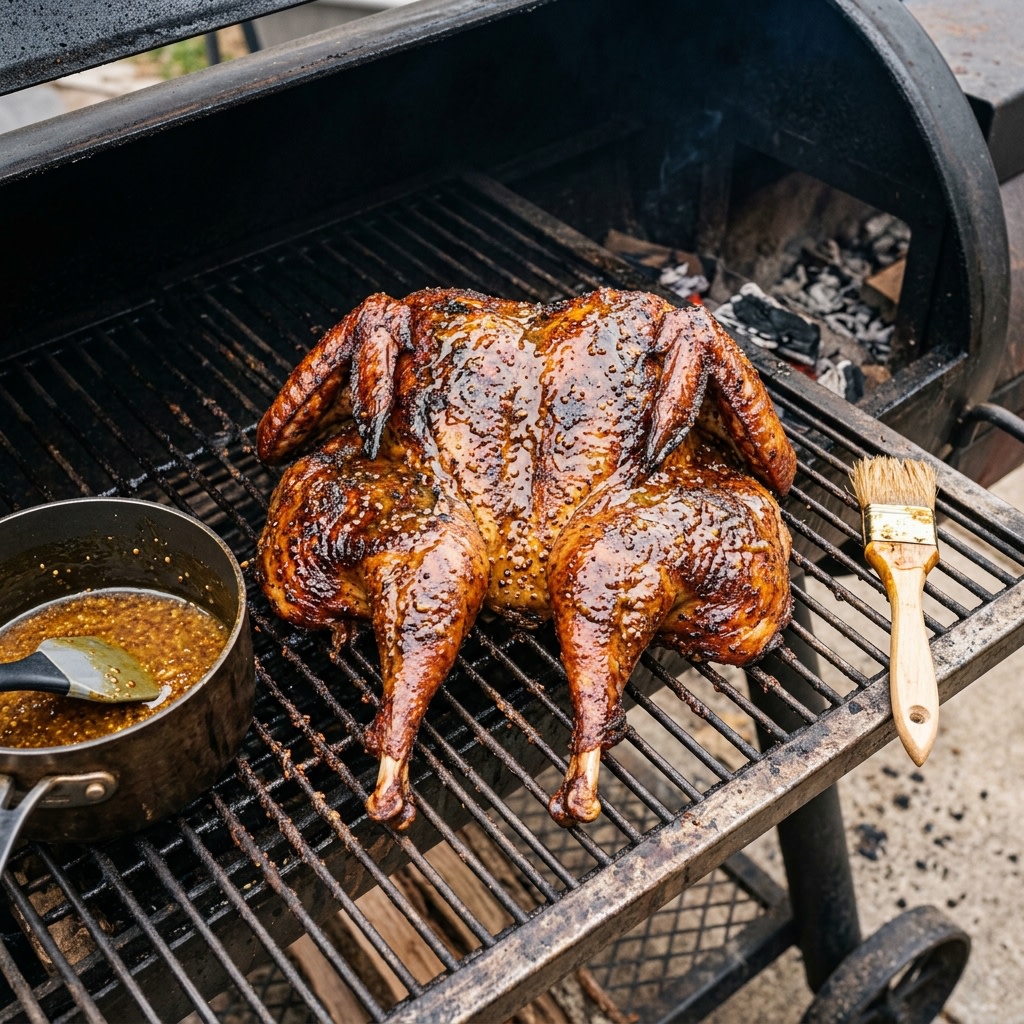
Spatchcocked Smoked Turkey for a Backyard Smoker: a flattened, dry-brined bird smoked at 275°F, basted with butter and finished with a honey-mustard glaze in the last minutes. Done in an afternoon on a kettle, offset or pellet grill.
Research Draft — Not Yet Kitchen-Tested
Independent adaptation. This is our own independently developed method, informed by the smoked turkey technique Matt Pittman has published: brine, spatchcock, butter baste and a late glaze. It is not his recipe and uses none of his branded brines or seasonings, and this page is not affiliated with, endorsed by, or officially connected to him or Meat Church. See the Matt Pittman profile for the technique background this method draws on.
Test status: researched and written from published technique and food-safety sources. We have not yet cooked and evaluated it in our kitchen. Go by the thermometer; the times below are only a guide.
What makes this distinctive
A whole turkey smoked upright is slow and uneven: the breast dries out while the legs catch up. Cutting out the backbone and laying the bird flat fixes most of that. The thighs sit closer to the heat, the breast cooks at the same pace, and a 12-pound bird finishes in about three hours. The brine seasons the meat through, the butter baste keeps the skin supple, and a honey-mustard glaze brushed on at the very end gives the skin a sticky, tangy finish that smoked turkey usually lacks.
What we changed
His published version uses an overnight wet brine made from his own branded product and his branded rub. We switched to a dry brine of plain kosher salt and brown sugar. It needs no bucket or fridge space for gallons of liquid, and the skin dries out while it sits, which helps it brown. The rub is a pantry blend with no added salt, since the brine already supplies it. Our glaze uses whole-grain mustard and cider vinegar for a sharper edge. And every stage is tied to a thermometer reading, with the breast and thigh checked separately.
Equipment
- Smoker, kettle grill or pellet grill with a grate wide enough for a flattened bird
- Heavy kitchen shears or poultry shears
- Leave-in probe thermometer, plus an instant-read thermometer
- Rimmed baking sheet with a wire rack, for dry brining in the fridge
- Basting brush and a small saucepan
- Large cutting board and a sharp carving knife
Ingredients
For the turkey and dry brine
- 1 whole turkey, 10–13 lb, fully thawed, giblets removed
- 3 tbsp kosher salt (use 2 tbsp if your salt is a dense, fine-grained brand)
- 1 tbsp light brown sugar
Rub (no salt)
- 1 tbsp coarse black pepper
- 2 tsp sweet paprika
- 2 tsp garlic powder
- 1 tsp onion powder
- 1 tsp dried thyme or rubbed sage
- ¼ tsp cayenne, optional
Baste and glaze
- 6 tbsp unsalted butter, melted, for basting
- 3 tbsp honey
- 2 tbsp whole-grain mustard
- 1 tbsp cider vinegar
- 2 tbsp butter
- A pinch of black pepper
Step by step
1. Thaw in the fridge
A frozen turkey needs several days in the fridge to thaw. Plan backwards from cook day, and see our turkey thawing and storage guide for the timings and safe shortcuts.
2. Spatchcock
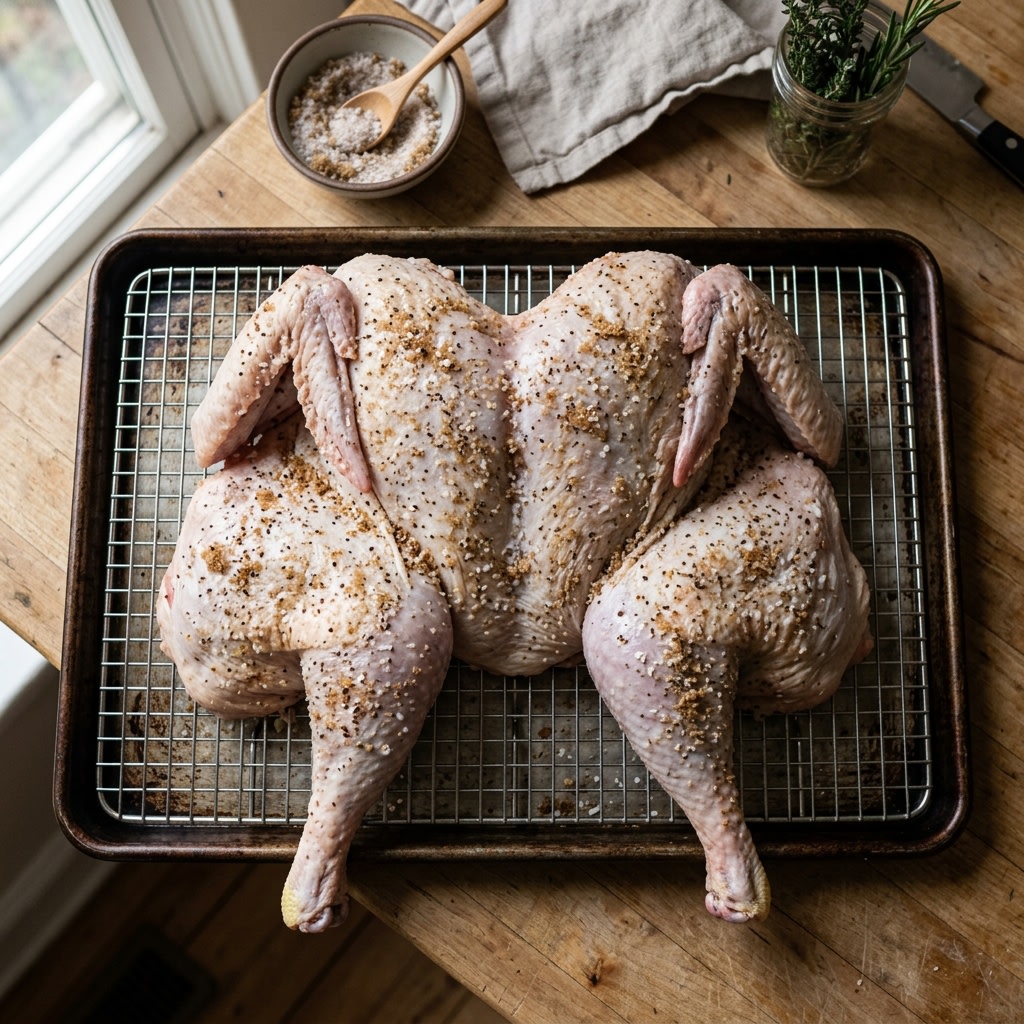
Set the bird breast side down. Cut along both sides of the backbone with shears and lift it out; keep it for stock. Flip the turkey, spread the legs and press hard on the breastbone with the heel of your hand until it cracks and the bird lies flat. Tuck the wing tips behind the breast.
3. Dry brine for 12–24 hours
Mix the salt and brown sugar. Loosen the skin over the breast and thighs with your fingers and rub about a third of the mix directly onto the meat. Season the rest of the bird all over, inside and out. Set it skin side up on the rack over the baking sheet and refrigerate uncovered for 12–24 hours.
4. Heat the smoker to 275°F
Set up for indirect heat at 275°F. Turkey takes on smoke easily, so use a milder wood such as apple, cherry, pecan or oak, and only a few chunks on a charcoal cooker.
5. Season and load
Pat the skin dry with paper towels. Brush on a thin coat of the melted butter, then sprinkle the rub evenly over the skin side. Lay the turkey skin side up with the legs toward the hotter side of the cooker. Insert a leave-in probe into the thickest part of the breast.
6. Smoke and baste
Leave the lid shut for the first hour. After that, brush on more melted butter every 45 minutes, working quickly so the cooker keeps its heat.
7. Glaze near the end
While the turkey cooks, warm the honey, mustard, vinegar, butter and pepper in a small pan until smooth. When the breast reads about 155°F, brush the glaze over the skin. Keep cooking until the breast and the thickest part of the thigh both read at least 165°F, usually 15–20 minutes more. The glaze should look tacky and set.
8. Rest and carve
Move the turkey to a board, tent it loosely with foil and rest for 20–30 minutes. Remove the legs at the joint and split them into drumsticks and thighs. Cut each breast off the bone in one piece, then slice it across the grain.
Temperature targets
| Stage | Target | Type |
|---|---|---|
| Smoker temp | 275°F | Process (USDA guidance for smoking poultry: 225–300°F) |
| USDA minimum safe temp, all poultry | 165°F in breast and thigh | Safety minimum |
| Thigh, tender dark meat | 175–185°F | Texture target (safe from 165°F) |
| Holding cooked turkey hot | 140°F or above | Safety |
Check more than one spot in both breasts and both thighs, keeping the probe tip off the bone. Our smoked turkey temperature guide covers probe placement in more detail.
Timing
A 10–13 lb spatchcocked turkey usually takes 2.5 to 3.5 hours at 275°F. Add 12–24 hours of dry brining the day before, 30 minutes to season and load, and 20–30 minutes of rest. Wind, cold weather and a heavier bird all push the cook longer, so start an hour earlier than you think you need and keep the finished turkey tented while the sides come together.
Visual and feel doneness signs
Colour is not a reliable sign that poultry is safe, so use these signs for texture and timing only. The thermometer decides when it is done.
- The skin is deep amber, taut and dry to the touch before the glaze goes on
- The drumsticks move loosely when you wiggle them
- The glaze is sticky and set, with no wet shine running off
Common mistakes
Wet skin going on
Moisture on the skin turns it rubbery in the smoker. Dry brine uncovered and pat it dry again before seasoning.
Glazing too early
Honey burns fast. Wait until the breast is about 10°F short of 165°F before you brush it on.
Checking only the breast
Both breast and thigh need to reach 165°F. On some cookers the thighs lag, so probe both every time.
Equipment-specific adaptations
Offset smoker
Keep the legs toward the firebox and the breast toward the chimney. A clean, small fire matters more here than with beef, since poultry picks up harsh smoke fast.
Kettle grill
Bank the coals on one side and set the bird on the other, legs toward the coals. Check that the flattened bird fits on the cool side with the lid closed before you light the coals. Our two-zone fire method covers the setup.
Pellet grill
Set 275°F and cook as written. Pellet grills give a mild smoke, which suits turkey well.
Substitutions
- Wet brine instead: dissolve ½ cup kosher salt and ¼ cup brown sugar in 1 gallon of cold water, submerge the flattened bird and refrigerate 8–12 hours, then rinse and dry well
- Turkey breast only: a bone-in breast follows the same steps and usually finishes in 1.5–2.5 hours
- Different glaze: maple syrup works in place of honey, and Dijon gives a smoother glaze than whole-grain mustard
- Chicken: the same method suits a spatchcocked chicken, which finishes in roughly 1.5 hours
Storage, reheating & food safety
Raw poultry keeps only 1 to 2 days in the fridge, so time the thaw and dry brine to land inside that window. Once cooked, do not leave turkey out for more than 2 hours, or 1 hour above 90°F. Carve the meat off the bone and refrigerate it in shallow containers. It keeps 3 to 4 days in the fridge, or 2 to 6 months in the freezer for best quality. Reheat leftovers to 165°F. Source: USDA Food Safety and Inspection Service and FoodSafety.gov. If leftovers smell or feel off, check our guide on how to tell if turkey is bad.
FAQ
Can I smoke it at 225°F instead?
It is within the USDA range for smoking poultry, but the skin tends to stay soft and rubbery at that heat and the cook takes much longer. 275°F gives better skin.
Can I stuff a spatchcocked turkey?
There is no cavity left to stuff. Bake the dressing in its own pan in the oven while the turkey smokes.
Why is the salt amount lower than some dry brine recipes?
Kosher salt brands vary a lot in density. We start on the lighter side so the turkey stays seasoned without tasting cured, and the rub carries no extra salt.