
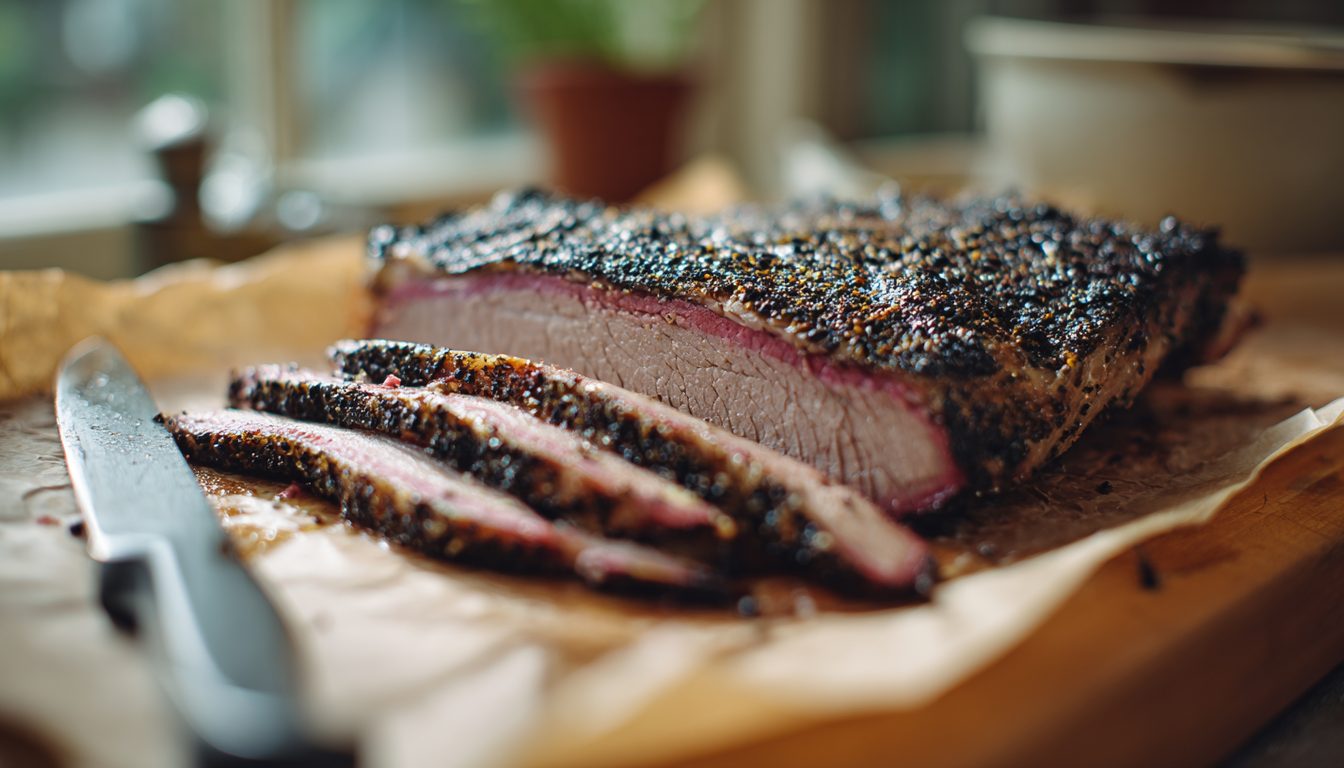
A brisket can read 203°F in the middle and still chew like a belt. That is the part the temperature charts leave out: on brisket, the thermometer tells you when to start checking, and your hand tells you when it is done. Here is the safe number, the texture window, and the test that actually decides it.
The 60-Second Answer
Whole beef brisket is safe at 145°F internal with a 3-minute rest, per USDA. It is tender somewhere between 195°F and 205°F, usually around 203°F, and the only reliable confirmation is that a probe slides into the thickest part of the flat with almost no resistance. Pull it on feel inside that window, not on a number alone.
Two Numbers That Do Two Different Jobs
145°F is a food-safety floor for whole-muscle beef. It says the pathogens that live on the surface of an intact cut have been dealt with. It says nothing about texture, and a brisket served at 145°F is safe and close to inedible.
195°F to 205°F is a texture target. Brisket is loaded with collagen, and collagen only breaks down into gelatin with sustained heat well above the safety minimum. That gelatin is what makes a slice bend without snapping and taste juicy even though the cut is lean. Keep the two numbers separate in your head and most brisket confusion disappears.
| Number | What it means | Source |
|---|---|---|
| 145°F + 3 min rest | Safe minimum for whole-muscle beef, including brisket | USDA FSIS |
| 160°F | Safe minimum for ground beef (does not apply to whole brisket) | USDA FSIS |
| 195–205°F | Texture window where collagen has rendered; not a safety figure | Cooking practice |
| 165°F | Reheat temperature for leftover cooked brisket | USDA FSIS |
Where to Put the Probe
A brisket is two muscles with different fat content, so it has two different readings at the same moment. The point (the thick fatty end) runs hotter and forgives more. The flat (the lean, even end) is the one that goes dry and the one that decides when you pull.
Probe the thickest part of the flat, going in from the side, parallel to the grate rather than straight down. Straight down runs the risk of parking the tip in a fat seam, which reads several degrees high and tells you the brisket is finished before it is. Check three or four spots across the flat: if one reads 199°F and another 206°F, believe the lower one.
The Stall Is Not a Problem to Fix
Somewhere around 150°F to 170°F the internal temperature stops climbing, sometimes for hours. That is evaporative cooling. Moisture leaving the surface pulls heat away as fast as the smoker puts it in, and the brisket sits there until the surface dries enough for the temperature to move again.
Two valid responses. Ride it out, which gives the darkest bark and the longest cook. Or wrap in butcher paper or foil once the bark has set, which cuts the stall short and shortens the cook by an hour or two. Foil pushes through fastest and softens the bark most; paper is the middle ground. What does not help is raising the pit temperature by 50°F in frustration, which dries the flat before the collagen has time to render.
Probe Tender: What You Are Feeling For
Once the flat is in the 195°F range, stop reading the number and start reading resistance. Slide the probe in slowly. Done brisket feels like pushing a thermometer into room-temperature peanut butter: a slight push through the bark, then nothing. If it grabs or pushes back in the middle, the collagen has not finished, and the answer is another 30 to 45 minutes, not a hotter fire.
Test several places. The point is almost always tender before the flat, so a soft reading there means nothing on its own.
Why One Brisket Finishes at 197°F and the Next at 208°F
Because “done” is a state, not a temperature. Grade and fat content change how much collagen there is to break down. A thin flat renders faster than a thick one. A wrapped brisket at 275°F takes a different path from an unwrapped one at 225°F, and the two arrive at tenderness at different readings. Anyone quoting a single magic number for every brisket is quoting an average.
Carryover and the Rest
Brisket keeps cooking after it leaves the smoker. Expect a few degrees of carryover in a large cut, which is one more reason to pull on feel at the bottom of the window rather than waiting for 205°F on the display.
Then rest it. An hour on the counter, loosely tented, is the minimum worth doing; two to four hours in a dry cooler with towels (the faux cambro) is better and is what most competition cooks do. Slicing straight off the smoker dumps rendered fat and juice onto the board instead of leaving it in the meat.
The one rule that matters while holding: keep it above 140°F. Below that you are in the danger zone, where bacteria multiply fastest, and a long warm hold at 120°F is a genuinely bad idea no matter how good the brisket looks. A cooler preheated with hot water holds a wrapped brisket above 140°F for hours. Read the full method in our guide to holding barbecue warm without drying it out.
After the Cook
Cooked brisket keeps 3 to 4 days in the refrigerator and 2 to 3 months in the freezer for best quality. Reheat leftovers to 165°F. If you are not sure whether a brisket that has been sitting in the fridge is still good, the checks are in how to tell if brisket is bad.
The Bottom Line
145°F makes brisket safe. 195°F to 205°F makes it tender, and inside that window the probe test decides. Measure the thickest part of the flat, pull when the probe meets no resistance, rest at least an hour above 140°F, and reheat any leftovers to 165°F.
Frequently Asked Questions
Is 190°F enough for brisket?
Occasionally, on a very fatty point, but rarely on the flat. At 190°F most briskets still feel firm when probed. It is safe to eat at that temperature; it is usually not tender yet.
Can brisket be overcooked?
Yes. Past roughly 210°F the muscle fibers have given up so much moisture that slices crumble instead of bending. If your brisket falls apart on the knife, you went too far, not too short.
Should I trust the probe that came with my smoker?
Test it before you trust it. Put the tip in an ice-water slurry: it should read 32°F within a degree or two. A probe that reads 6°F high is the reason a brisket “at 203°F” came out tough.
Do I have to wrap brisket?
No. Wrapping shortens the stall and protects the flat; going unwrapped builds better bark and takes longer. Both get to the same texture window, just by different routes and at slightly different times.
Related Guides
- What Temp Are Ribs Done? Safe vs Tender Explained
- How to Tell if Brisket Is Bad
- Smoked Brisket Recipe (Aaron Franklin Method)
- How to Keep Barbecue Warm After Cooking
Never Throw Out Good Meat Again
Get the one-page BBQ cheat sheet: fridge and freezer times for every cut, safe temperatures, and the spoilage signs that are false alarms. Free, no spam.
No spam, and you can unsubscribe any time.