
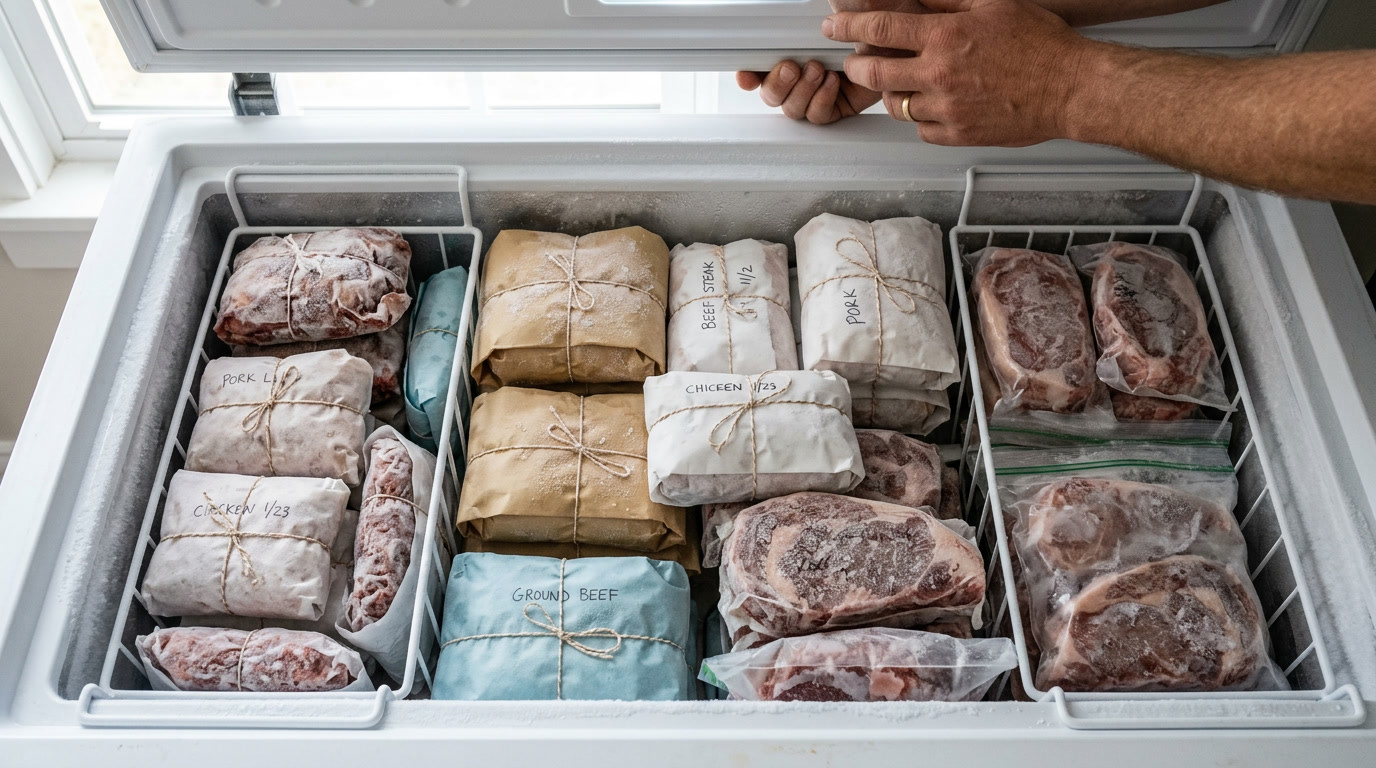
You are digging through the chest freezer and find a pork shoulder dated last spring, a bag of mince with no date at all, and half a brisket someone wrapped in foil. Every chart online gives a different number of months, and few say what that number measures: how long the meat stays good to eat. Whether it is still safe is a separate question with a much shorter answer.
The 60-Second Answer
Meat held at a constant 0°F or below stays safe indefinitely. The months you see on storage charts are quality guidance from FoodSafety.gov: 4 to 12 months for steaks, chops and roasts, 3 to 4 months for ground meat, 1 year for a whole chicken or turkey, and 2 to 6 months for cooked leftovers. Past those windows the meat is still safe, only drier and duller.
Freezer Times by Cut
The freezer column below is the FoodSafety.gov Cold Food Storage Chart, and every figure in it is about quality. The fridge column is the safety window for raw meat at 40°F or below, so freeze before it runs out.
| Food | Freezer at 0°F (quality) | Fridge at 40°F (freeze before this runs out) |
|---|---|---|
| Beef, pork, lamb or veal steaks, chops and roasts | 4–12 months | 3–5 days |
| Ground meat and ground poultry | 3–4 months | 1–2 days |
| Whole chicken or turkey | 1 year | 1–2 days |
| Chicken or turkey pieces | 9 months | 1–2 days |
| Fresh ham, uncured and uncooked | 6 months | 3–5 days |
| Bacon | 1 month | 1 week |
| Raw sausage | 1–2 months | 1–2 days |
| Fully cooked sausage | 1–2 months | 1 week |
| Hot dogs | 1–2 months | 1 week opened, 2 weeks unopened |
| Cooked meat or poultry leftovers | 2–6 months | 3–4 days |
| Soups and stews with meat, including chili | 2–3 months | 3–4 days |
Notice where the short windows fall. Bacon and sausage, the salted and fatty items, have the least freezer time of anything on the list, because fat picks up stale and rancid flavours in the cold long before lean muscle does. Whole birds get the longest. For smoked meat, chili and the rest of what comes off the pit, the fridge and freezer times are in how long BBQ leftovers are good for.
Freezer Burn Is a Quality Problem
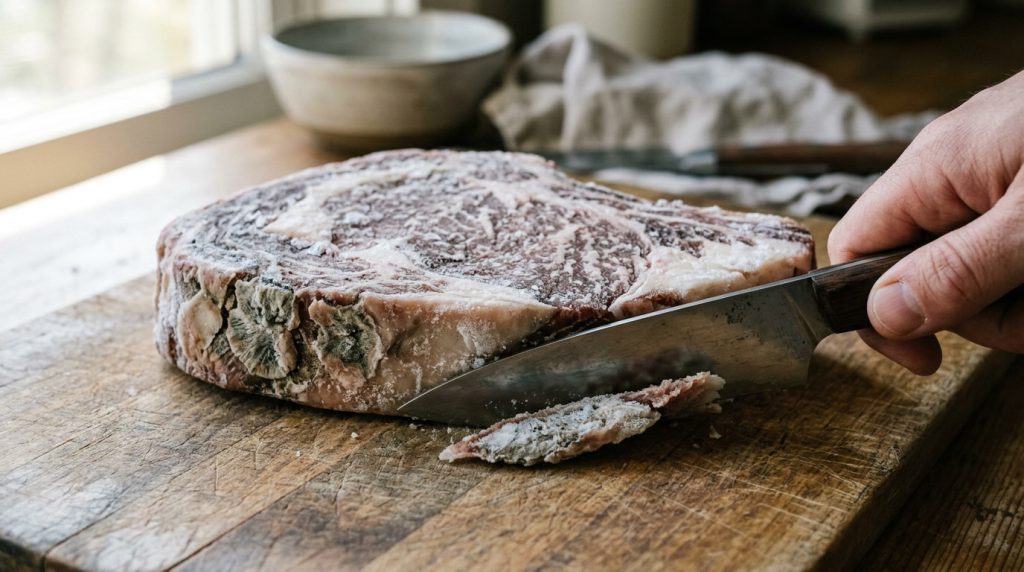
Freezer burn shows up as dry, grey-brown patches on the surface of the meat, sometimes pale and leathery at the edges. It forms wherever air touches the meat and draws moisture out of the surface. The meat underneath is safe. The burned spots cook up tough and taste of the freezer, so trim them off with a sharp knife before cooking and use the rest as normal.
A roast burned across most of its surface is still safe, but it has lost enough moisture that a braise or a pot of chili will treat it better than a hot grill.
Two other things look alarming and usually are not. Vacuum-packed beef turns dark purple or brown because there is no oxygen in the bag, and that colour on its own is not spoilage. The same packs can release a faint sealed-in smell when opened, which USDA calls confinement odor; it should fade once the meat sits open to the air. If it stays, go through the checks in how to tell if steak is bad before you cook it.
Wrap It So the Chart Holds
Every freezer time on that chart assumes the meat is sealed well. Air is what causes freezer burn, so the job of the wrapping is to keep air off the surface:
- Press every bit of air out of freezer bags before sealing, or use a vacuum sealer if you have one.
- Wrap tightly in freezer paper or plastic wrap, then overwrap store trays, which are made for the fridge case and let air in over time.
- Freeze in the portions you will actually cook, so nothing gets thawed twice for no reason.
- Write the cut and the date on every package.
Then check the freezer itself. The indefinite-safety rule depends on a steady 0°F, and a freezer thermometer is the only way to know you have it.
Thawing and Refreezing
The refrigerator is the safest place to thaw, and the slowest: a whole turkey needs about 24 hours for every 4 to 5 pounds. When you are short on time, a sealed bag in cold water with the water changed every 30 minutes is the fast option, and the full method is in how to thaw meat fast. Meat thawed in the microwave has to be cooked straight away.
The thawing method also decides whether the meat can go back in the freezer. Fridge-thawed raw meat can be refrozen without cooking. Meat thawed in cold water or the microwave has to be cooked first, and can you refreeze meat covers every version of that question. The counter is never a thawing method, and the reasons are laid out in what to do with meat left out overnight.
The Bottom Line
At a steady 0°F, frozen meat is safe for as long as it stays frozen. The months on the chart tell you when quality starts to slip, from a single month for bacon to a year for whole birds. Wrap tightly, label everything, trim any freezer burn, and thaw in the fridge or in cold water.
Frequently Asked Questions
Is meat frozen longer than the chart says still safe to eat?
If it stayed frozen at 0°F the whole time, yes. Expect it to be dry and possibly freezer burned, so it is better suited to slow cooking or a sauce than to a quick sear.
Should I throw out meat with freezer burn?
No. Freezer burn dries out the surface and dulls the flavour, and the meat stays safe to eat. Trim the grey-brown patches off and cook the rest.
Does vacuum sealing make meat last longer in the freezer?
It helps quality because it keeps air off the surface, which is what causes freezer burn. It does not change the safety picture, since meat held at 0°F is already safe indefinitely.
What if the power went out and the freezer warmed up?
Meat that still has ice crystals or is at 40°F or below can be refrozen. Anything that sat above 40°F for more than 2 hours should be discarded.
Related Guides
- Can You Refreeze Meat?
- How to Thaw Meat Fast (Safely)
- How Long Does Smoked Meat Last?
- How Long Are BBQ Leftovers Good For?
Never Throw Out Good Meat Again
Get the one-page BBQ cheat sheet: fridge and freezer times for every cut, safe temperatures, and the spoilage signs that are false alarms. Free, no spam.
No spam, and you can unsubscribe any time.