Method Guide · Inspired By Aaron Franklin
Backyard Brisket, Franklin-Style
Aaron Franklin–Inspired Brisket Method for a Backyard Smoker — the trim, the rub, the wrap and the fire management, adapted for a smaller offset, pellet smoker or kettle grill instead of a commercial pit.
Research Draft — Not Yet Kitchen-Tested
Independent adaptation, not an official recipe. This is our own independently developed method, informed by Aaron Franklin’s publicly documented technique. It is not his recipe, and this page is not affiliated with, endorsed by, or officially connected to him or Franklin Barbecue. See the Aaron Franklin profile for the technique background this method is based on.
Test status: this method has been researched and written from verified technique and food-safety sources but has not yet been physically cooked and evaluated in our kitchen. Treat timings as ranges to plan around, not guarantees — use a thermometer and the doneness signs below, not the clock.
Backyard Brisket, Franklin-Style
Our independently developed adaptation of Aaron Franklin’s publicly documented brisket technique, sized for a backyard offset, pellet or kettle smoker. Research Draft – not yet kitchen-tested; see the full method guide for equipment notes and troubleshooting.
- Prep Time: 45 minutes
- Cook Time: 12-18 hours
- Total Time: 13-19 hours
- Yield: 10-12 servings 1x
- Category: Main Course
- Method: Smoking
- Cuisine: American, Texan
Ingredients
- 1 whole packer brisket, 10–14 lb, point and flat still attached
- 2 tbsp coarse kosher salt per 5 lb of trimmed brisket weight
- 2 tbsp coarse (16-mesh / butcher grind) black pepper per 5 lb of trimmed brisket weight
Instructions
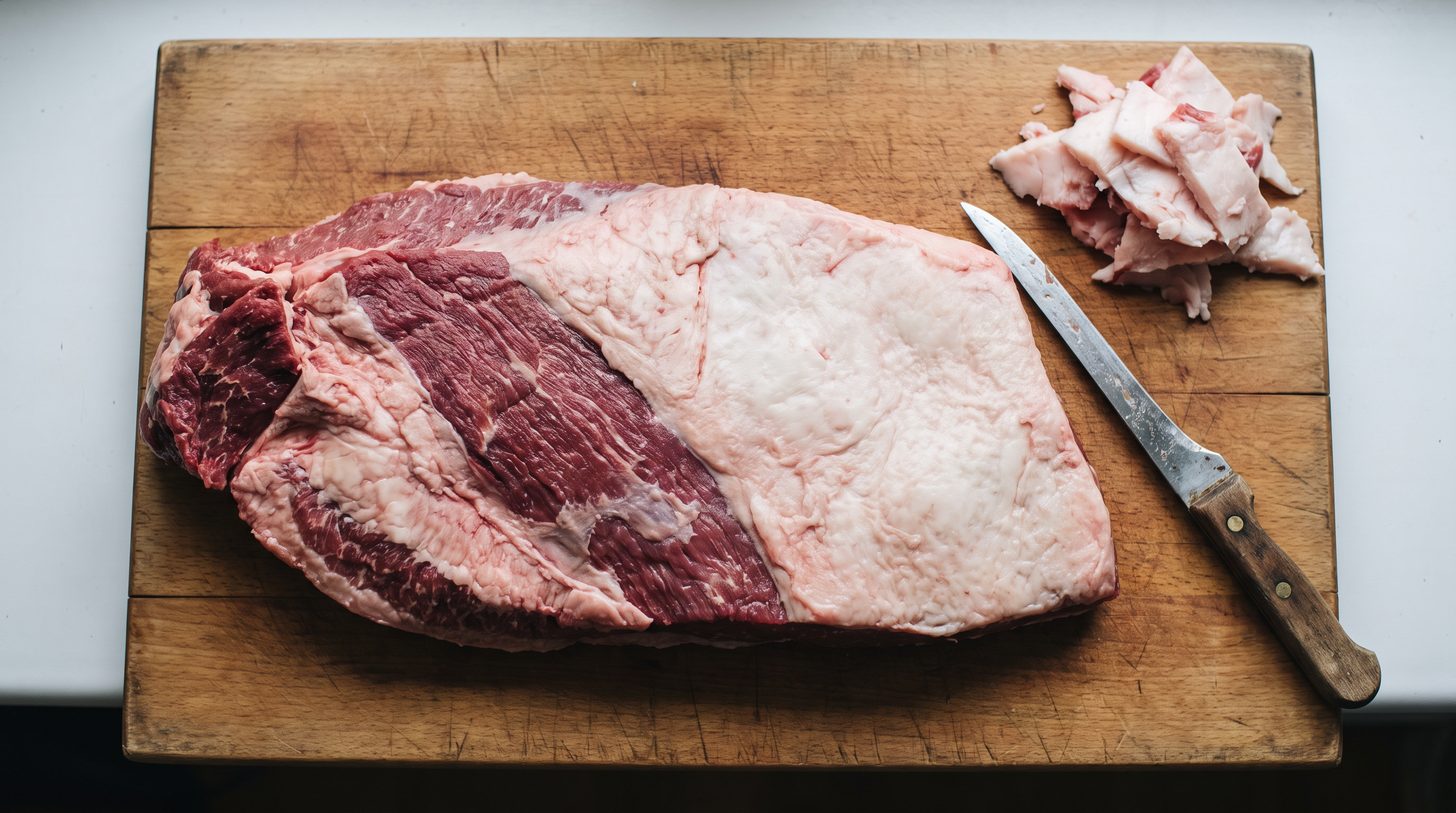
- Trim hard fat to about ¼ inch and round the edges for even cooking. 30–45 minutes.
- Season evenly with the salt and pepper. Rest uncovered in the fridge at least 30 minutes, or overnight.
- Bring the smoker to a steady 250°F using post oak, or hickory/mild fruitwood as a substitute.
- Smoke unwrapped until the bark is dark and set, roughly 6–8 hours for a 12 lb brisket – expect a stall around 150–170°F internal.
- Wrap tightly in two overlapping sheets of butcher paper once the bark is no longer tacky.
- Continue smoking at 250°F until a probe slides in with almost no resistance, typically 195–204°F internal – roughly 2–4 more hours.
- Rest wrapped, in a cooler or turned-off oven, for at least 1 hour and up to 4.
- Separate the point and flat at the fat seam and slice each against its own grain.
Notes
145°F + 3 minutes rest is the USDA minimum safety temperature for whole cuts of beef – this brisket is cooked well past that, to 195–204°F, for texture, not safety. See the full method guide for equipment-specific adaptations and troubleshooting.
What makes this method distinctive
Most backyard brisket recipes lean on a heavy rub or a sauce to cover for an inconsistent cook. This method does the opposite: almost no seasoning complexity, and all the effort put into trimming, fire management and a mid-cook wrap — because that’s genuinely where a Central Texas-style brisket’s flavour and texture come from, not from the spice cabinet.
What we changed for a backyard setup
Smaller cut
A 10–14lb packer brisket instead of the 16lb+ often used commercially — still enough meat to render properly without needing a pit built for volume.
Any smoker type
Written for offset, pellet or kettle (snake method) — the trim and rub logic is identical; only the fire-tending instructions differ.
Realistic timing
A time range per pound rather than a single number, because stall length varies more than most recipes admit.
Equipment
- Offset smoker, pellet smoker, or kettle grill set up for indirect heat (charcoal banked to one side, or the “snake”/fuse method)
- Instant-read or leave-in probe thermometer — this method is temperature- and feel-led, not clock-led
- Sharp boning or trim knife
- Pink/peach butcher paper, unwaxed (not the same as parchment or waxed paper — waxed paper is not food-safe at smoking temperatures)
- Large cutting board and a cooler or empty (unpowered) oven for resting
Ingredients
- 1 whole packer brisket, 10–14 lb, point and flat still attached
- 2 tbsp coarse kosher salt per 5 lb of trimmed brisket weight
- 2 tbsp coarse (16-mesh / butcher grind) black pepper per 5 lb of trimmed brisket weight
That’s the full ingredient list. Weigh the trimmed brisket, not the packer weight on the label, and scale the salt and pepper from that — trimming typically removes 1–2 lb.
Step by step
1. Trim (30–45 min, the night before or morning of)
Trim hard white fat down to about ¼ inch across the fat cap. Remove the thin, ragged “mouse” section at the point end and any loose silverskin. Round off the edges of the flat so the whole brisket cooks at a more even rate — you’re aiming for a rounded, even shape rather than the rectangular one it starts as.
2. Season and rest uncovered (30 min – overnight, in the fridge)
Apply the salt and pepper evenly on all sides, patting rather than rubbing it in. Rest uncovered in the fridge for at least 30 minutes, or overnight if your schedule allows — the surface dries slightly, which helps bark form.
3. Set up the fire (225–275°F)
Bring the smoker to a steady 250°F. Add post oak if you can get it; hickory or a mild fruitwood is a reasonable substitute outside Texas. The goal is thin blue smoke — if it’s billowing white, the fire needs more air or a smaller wood addition.
4. Smoke unwrapped until the stall (roughly 6–8 hours for a 12lb brisket)
Fat side up or down is a genuine point of disagreement among pitmasters; either works. Maintain 250°F, adding fuel every 45–60 minutes on an offset. Expect the internal temperature to climb steadily, then flatten out somewhere in the 150–170°F range for an hour or more — this is the stall, caused by evaporative cooling, not a sign anything is wrong.
5. Wrap in butcher paper once bark is set
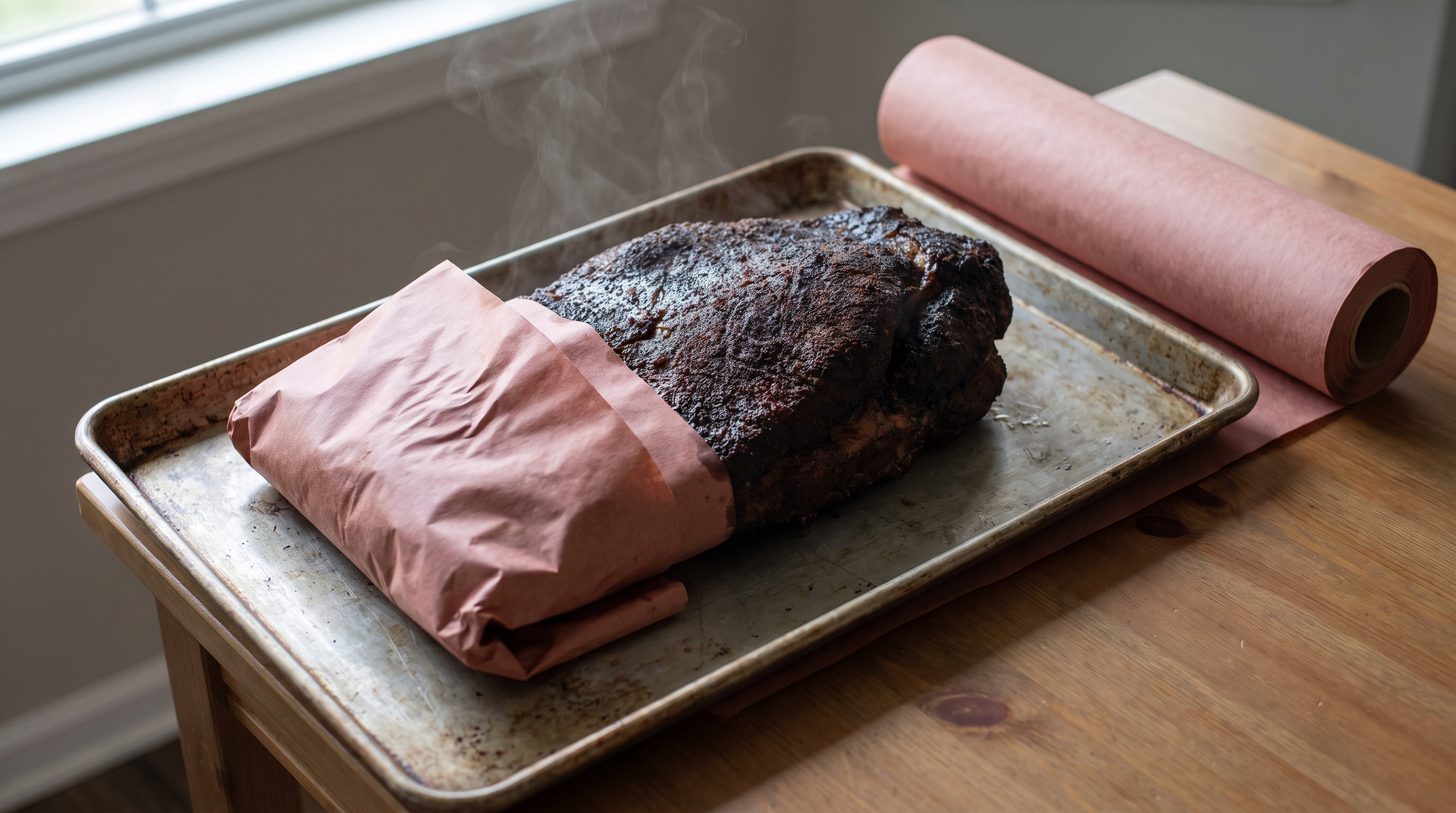
When the bark is dark and no longer tacky to the touch (usually once through the stall, or once you’re satisfied with the colour), wrap tightly in two overlapping sheets of butcher paper. This isn’t a food-safety step — it’s there to push through the stall faster while keeping the bark firmer than foil would.
6. Continue to probe-tender (roughly 2–4 more hours)
Keep smoking at 250°F until a probe slides into the thickest part of the flat with almost no resistance — typically somewhere in the 195–204°F range, though the feel matters more than the exact number.
7. Rest (minimum 1 hour, ideally 2–4)
Rest wrapped, in a cooler or a turned-off oven, for at least an hour before slicing — longer improves juiciness. Internal temperature will keep dropping slowly; that’s expected.
8. Slice against the grain
The flat and point have grain running in different directions — separate them at the natural fat seam and slice each piece against its own grain, about pencil-width thick.
Temperature targets
| Stage | Target | Type |
|---|---|---|
| Smoker temp | 250°F | Process |
| USDA minimum safe temp, whole beef | 145°F + 3 min rest | Safety minimum |
| Wrap point | 150–170°F internal | Process |
| Probe-tender finish | 195–204°F internal | Texture target, not a safety figure |
145°F is the point at which the meat is safe. It is nowhere near done in the textural sense this method is going for — brisket needs the extra hours to break down connective tissue regardless of food safety.
Timing — a range, not a promise
Roughly 1 to 1.5 hours per pound at 250°F, so a 12lb brisket is realistically an 12–18 hour project including rest — but stall length is genuinely unpredictable. Plan the cook to finish 2–4 hours before you need to serve, and hold it (wrapped, in a cooler) rather than rushing the finish.
Visual and feel doneness signs
- Probe slides in with almost no resistance, “like butter,” across the thickest part of the flat
- The brisket jiggles like a firm jelly when you shake the grate lightly
- Bark is dark mahogany to near-black, not soft or wet-looking
- A smoke ring — a pink band just under the surface — is a smoke-and-myoglobin reaction, not a doneness indicator; don’t chase it or judge doneness by it
Common mistakes
Skipping the trim
An untrimmed brisket cooks unevenly — thin sections dry out before the thick end is done.
Chasing a single number
Pulling at exactly 203°F regardless of feel. Two briskets rarely finish at the same number.
Skipping the rest
Slicing straight off the smoker loses far more juice than a 1–2 hour rest costs you in serving time.
Wrapping too early
Wrapping before bark has set softens it — wait until the surface is no longer tacky.
Equipment-specific adaptations
Offset smoker
As written above — tend the fire every 45–60 min for clean smoke.
Pellet smoker
Set and hold 250°F; smoke flavour will be milder, so consider a smoke tube for the first few hours if your model supports one.
Kettle grill (snake/fuse method)
Arrange charcoal in a horseshoe with wood chunks along the top; refill the end of the snake roughly every hour. Harder to hold rock-steady at 250°F — expect more temperature drift and check more often.
Substitutions
- Wood: hickory or a mild fruitwood (apple, cherry) in place of post oak — different but good, not a downgrade
- Pepper: if 16-mesh isn’t available, coarsely crack whole peppercorns yourself rather than using pre-ground fine pepper, which disappears into the bark instead of forming it
- Butcher paper: uncoated, food-safe kraft paper works if you can’t find pink butcher paper specifically; never use wax paper
Storage, reheating & food safety
Refrigerate sliced or whole brisket within 2 hours of coming off the smoker (1 hour if the surrounding temperature is above 90°F). Refrigerated, it keeps 3–4 days; for longer storage, freeze — well-wrapped brisket holds good quality for 2–3 months in the freezer.
Reheat gently, covered, at a low oven temperature with a splash of beef stock to add back moisture, until warmed through to at least 165°F if it’s been fully refrigerated. Source: USDA Food Safety and Inspection Service cold storage and reheating guidance.
FAQ
Do I have to use butcher paper?
No — foil works and cooks slightly faster through the stall, but tends to soften the bark more. Butcher paper is a texture preference, not a requirement.
What if my brisket stalls for much longer than expected?
That’s normal and highly variable. Keep the smoker steady and wait it out, or wrap earlier to push through it — don’t raise the smoker temperature sharply to force it, which risks the outside overcooking before the inside catches up.
Can I use this method on a smaller flat-only cut?
Yes, with a shorter total cook time — a flat alone has less fat to protect it, so watch it more closely in the last hour to avoid drying out.