
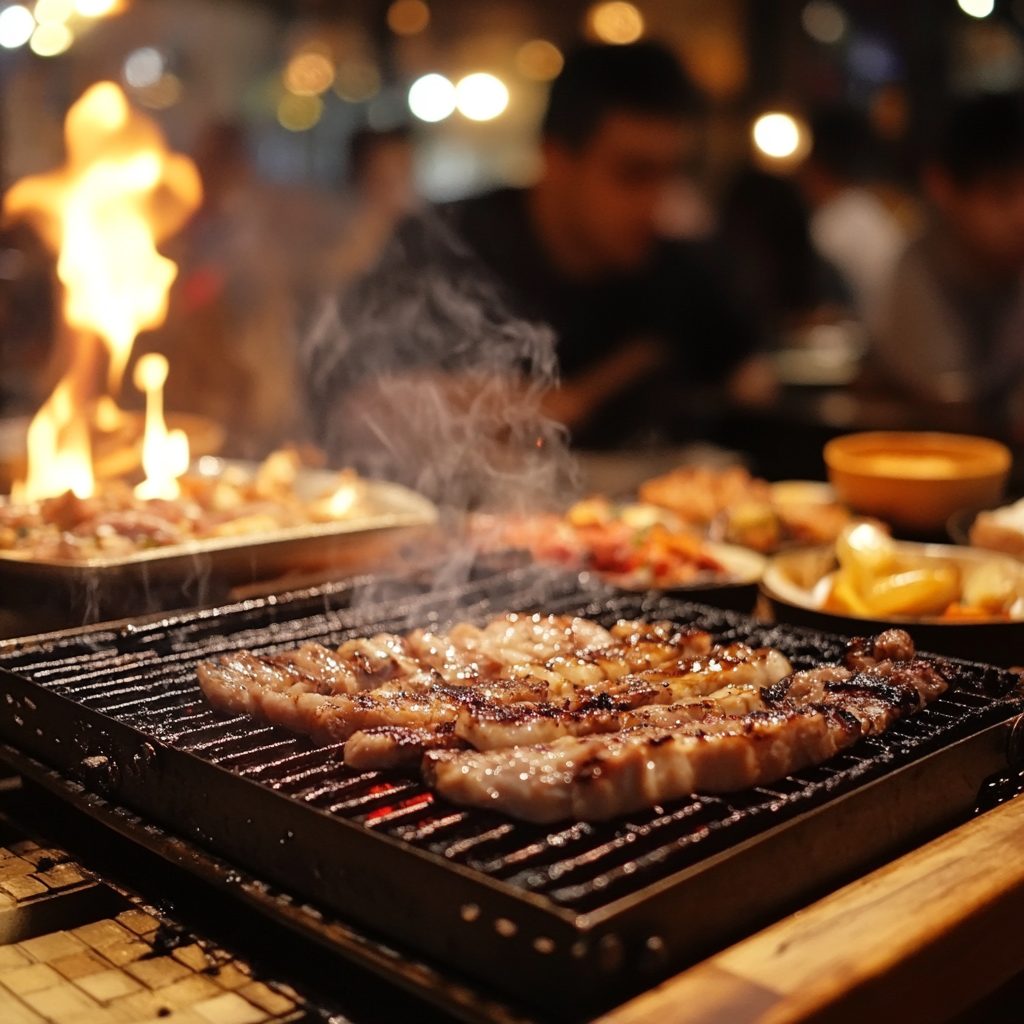
Korean BBQ at a restaurant means a grill built into your table and someone else doing the cooking. At home, the two things that actually matter are the same: cut the meat thin, and cook it hot and fast over direct heat. Everything else — the banchan, the lettuce wraps, the specific marinade — is detail on top of that.
Why thin cuts change everything
Standard American steak cuts are an inch or more thick, cooked to a target internal temperature over several minutes with a rest afterward. Korean BBQ cuts — bulgogi, galbi, thin-sliced short rib — are sliced ⅛ to ¼ inch thick, sometimes against the grain, sometimes with it depending on the cut. That thinness is what makes tabletop grilling work at all: a piece that thin cooks through in 60–90 seconds per side over high heat, with no need to manage a temperature curve. There’s no stall, no resting requirement, no probe. It’s done when it’s browned and no longer pink in the center, which you can see happen in real time.
The marinade is a flavour and tenderness tool, not a safety step
A classic bulgogi marinade is soy sauce, grated Asian pear or apple, garlic, ginger, a little sugar, sesame oil, and black pepper. The fruit isn’t there for sweetness alone — its natural enzymes (bromelain-like activity in pear) help tenderize thin-cut beef in a short marinating window, which matters because these cuts marinate for 30 minutes to a few hours, not overnight.
| Ingredient | Amount (for 1.5 lb thin-sliced beef) |
|---|---|
| Soy sauce | ⅓ cup |
| Asian pear or apple, grated | ½ cup, with juice |
| Garlic, minced | 4 cloves |
| Fresh ginger, grated | 1 tsp |
| Brown sugar | 2 tbsp |
| Toasted sesame oil | 2 tbsp |
| Black pepper | ½ tsp |
| Green onion, sliced | 2, plus more to serve |
Combine everything, toss with the thin-sliced beef, and refrigerate 30 minutes to 4 hours. Longer than that and the pear’s enzymes can start breaking the texture down into mush rather than just tenderizing it — this is a case where more marinating time is not better.
Equipment: what actually gets you close to the restaurant version
- Tabletop butane grill or electric griddle — closest to the real experience, cooks fast enough that everyone eats hot food as it comes off.
- A hot cast-iron pan or griddle — works well indoors; get it ripping hot before the meat goes on, since the thin cuts need high heat to sear rather than steam.
- An outdoor grill, direct high heat — use a grill basket or fine grate insert so the thin slices don’t fall through, and keep them over the hottest direct zone.
How to cook it
- Bring the marinated beef to near room temperature for about 15 minutes before cooking — cold meat straight from the fridge cools the pan and steams instead of searing.
- Heat your pan, griddle or grill until genuinely hot — a drop of water should skitter and evaporate almost instantly.
- Lay the slices in a single layer without crowding. Crowding drops the surface temperature and you get grey, boiled-looking meat instead of a seared edge.
- Cook 60–90 seconds per side, until browned at the edges and no longer pink in the center. Thin cuts go from perfect to overdone in under a minute, so stay at the pan.
- Serve immediately, ideally in batches straight off the heat rather than holding a full platter — this is food that’s built to be eaten hot, a few pieces at a time.
Doneness and food safety
Ground beef needs to reach 160°F internally to be safe; whole-muscle beef cuts like this one are safe at 145°F with a 3-minute rest, per USDA guidance. In practice, a thin-sliced cut cooked to visible browning with no pink center will already be well past that safety threshold — the challenge with these cuts is stopping before they overcook, not undercooking them.
What to serve alongside
- Lettuce or perilla leaves — wrap a piece of meat, a little rice, and a dab of sauce
- Quick pickled vegetables — cucumber or radish in vinegar and a little sugar, made an hour ahead
- Steamed short-grain rice
- A dipping sauce — sesame oil with a pinch of salt is the simplest version; a mix of soy sauce, vinegar and gochujang is the sharper one
Common mistakes
- Cutting the meat too thick. If you’re slicing it yourself, partially freeze the beef for 30–45 minutes first — it’s much easier to get thin, even slices from firm, semi-frozen meat than from fully soft meat at room temperature.
- Marinating too long. More than 4 hours with a pear-based marinade starts to break down texture rather than improve it.
- Overcrowding the pan. Cook in batches. A crowded pan can’t stay hot enough to sear.
- Cooking straight from the fridge. Cold meat drops pan temperature and steams instead of browning.
Storage and reheating
Refrigerate raw marinated beef and use within 3–5 days, or freeze the marinated meat for up to 3 months — it actually freezes well since it’s already thin. Cooked leftovers keep 3–4 days refrigerated; reheat in a hot pan briefly rather than the microwave, which tends to make thin-sliced beef rubbery.
FAQ
Can I use chicken or pork instead of beef?
Yes — thin-sliced chicken thigh or pork shoulder both work with the same marinade and technique. Pork and chicken need to reach 145°F and 165°F internally, respectively, which visible browning and firm texture will confirm on cuts this thin.
What cut of beef should I ask for?
Ribeye or sirloin, asked to be sliced thin (or “for BBQ/hot pot” at a Korean or Asian grocery, which usually stocks pre-sliced options). Short rib cut flanken-style — across the bones rather than between them — is the cut behind galbi specifically.
Do I need a special Korean BBQ grill?
No. A tabletop butane burner is closest to the restaurant experience, but a hot cast-iron pan or a grill’s direct zone gets you the same result — thin cuts, high heat, short cook time is what matters, not the specific equipment.
For the fire-management fundamentals behind any high-heat direct grilling — not just this style — see our beginner’s grilling guide. And for the general-purpose marinade principles this one is built on, see our low-sugar marinade guide.