
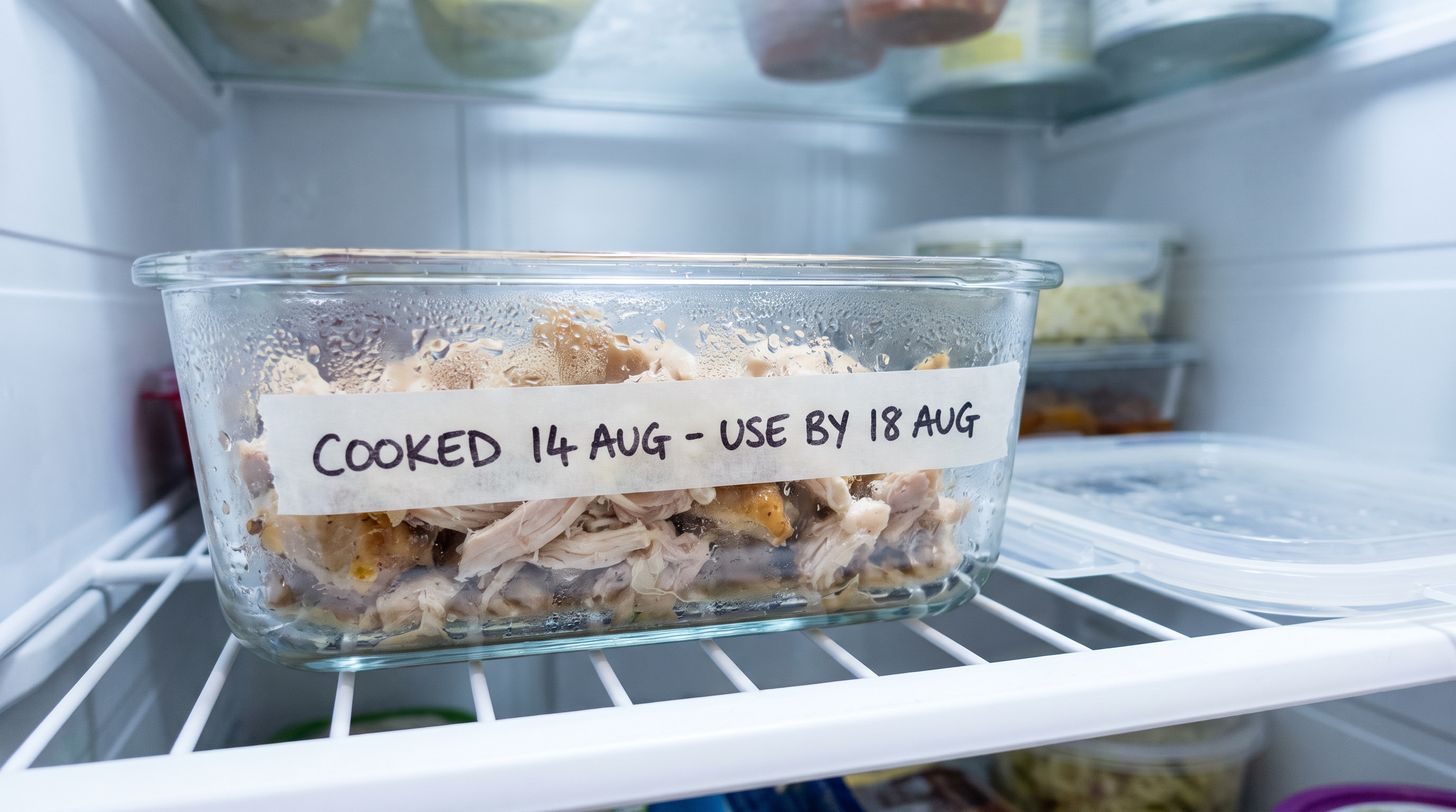
There’s half a roast chicken in a container at the back of the fridge and nobody can remember which night it came out of the oven. Here’s how to decide, and how long you actually had.
The Short Answer
- Cooked chicken keeps 3 to 4 days in a fridge running at 40°F (4°C) or below.
- In the freezer it stays safe indefinitely at 0°F (-18°C), with best quality inside 2 to 6 months.
- The clock starts when the chicken comes off the heat, not when it goes in the fridge.
- Past four days it goes in the bin, however good it looks.
Those figures come from USDA cold storage guidance, and the fridge number is a safety limit rather than a suggestion.
The Numbers, by Type
| Cooked chicken | Fridge (40°F) | Freezer (0°F) |
|---|---|---|
| Roast, grilled or smoked, on the bone | 3 to 4 days | 2 to 6 months |
| Sliced or shredded | 3 to 4 days | 2 to 6 months |
| Fried chicken | 3 to 4 days | up to 4 months |
| Chicken in sauce, curry or casserole | 3 to 4 days | 2 to 3 months |
| Chicken soup or stew | 3 to 4 days | 2 to 3 months |
| Chicken nuggets or patties | 3 to 4 days | 1 to 3 months |
| Shop-bought rotisserie | 3 to 4 days from when it was cooked | 2 to 6 months |
The two columns mean different things. The fridge figures are safety limits. The freezer figures are about quality only — chicken held continuously at 0°F is safe forever, it simply gets progressively less pleasant to eat.
The Rotisserie Chicken Trap
This one catches people out weekly. A supermarket rotisserie bird was cooked hours before you bought it, then sat under a warming lamp, then rode home in a car.
Your three to four days started in the shop’s kitchen, not at your front door. Treat the day of purchase as day one at best, and if it sat in a warm car for half an hour on the way home, treat it as day one and a half.
Carve the meat off the carcass while it’s still warm and refrigerate it in a shallow container. A whole bird cools far too slowly in the middle, and the bones take up space you could use for a faster chill.
Cool It Fast, or the Clock Doesn’t Matter
Bacteria multiply fastest between 40°F and 140°F, a range the USDA calls the Danger Zone, doubling in number in as little as 20 minutes. Everything below follows from that.
- Into the fridge within 2 hours of coming off the heat. 1 hour if the room is above 90°F, which a kitchen easily is after a long roast.
- Shallow containers, not one deep tub. A deep container holds Danger Zone temperatures in the centre for hours while the edges chill.
- Don’t wait for it to cool first. Modern fridges handle warm food. The two-hour clock matters far more than the appliance does.
- Never cool it overnight on the counter. This is the single most common way good chicken becomes dangerous chicken.
Storing It Properly
An airtight container or a well-sealed bag, on a lower shelf so nothing can drip onto food below it. Keep it away from anything raw.
Check your fridge is actually at 40°F or below with a cheap appliance thermometer. The dial saying “4” is not a temperature, and a fridge running warm quietly shortens every number in the table above.
Freezing
- Freeze on day one, not day three. Freezing pauses quality, it doesn’t restore it — chicken frozen on its last good day thaws out as last-good-day chicken.
- Press the air out. Air causes freezer burn, which is safe to eat but dry and flat.
- Portion before freezing so you thaw only what you’ll eat.
- Freeze saucy dishes with their sauce — the liquid protects the meat from drying.
- Label with the date. Every frozen container looks identical in three months.
Thawing and Reheating
Thaw in the fridge overnight, in a sealed bag under cold running or changed water, or in the microwave if you’re cooking it immediately afterwards. Never on the counter — the surface reaches Danger Zone temperature long before the middle softens.
Reheat to 165°F, the USDA figure for leftovers, measured in the thickest part. Cover it and add a splash of stock so the meat steams rather than dries. Reheat only the portion you’re going to eat: every heat-and-chill cycle costs quality and adds risk.
Is It Still Good?
| What you notice | Verdict |
|---|---|
| More than 4 days in the fridge | Bin it, whatever it looks like |
| Slimy or sticky on the meat itself | Bin it — that’s a bacterial biofilm |
| Sour, sulphurous or ammonia smell | Bin it |
| Any fuzzy growth, green, white or black | Bin it, the whole container |
| Left on the counter overnight | Bin it — no smell test applies |
| Slightly dull or greyish colour, smells clean | Fine — cooked poultry fades in the fridge |
| Dry edges, firm texture | Fine — that’s moisture loss, a quality issue |
| Pink near the bone on smoked chicken | Fine — smoke leaves poultry pink well above 165°F |
Note the order. Check the calendar first, because time is the signal that fails silently — the bacteria that make you ill are not the same organisms as the ones that make food smell bad, so chicken can be unsafe while still smelling perfectly fine.
And don’t taste a small piece to test it. That’s the one check that can’t tell you anything useful before it’s already too late.
The Bottom Line
- 3 to 4 days cooked, in the fridge, counted from when it left the heat.
- 2 to 6 months frozen for best quality; safe indefinitely at 0°F.
- 2 hours maximum out of refrigeration, 1 hour above 90°F.
- 165°F when reheating.
- Slime or a sour smell ends the conversation regardless of the date.
In the United States, the USDA Meat and Poultry Hotline answers questions about specific food free on 1-888-674-6854.
Frequently Asked Questions
Can I eat cooked chicken after 5 days?
No. The limit is 3 to 4 days even in a cold fridge. Listeria grows at refrigeration temperatures, which is why the limit doesn’t stretch just because your fridge runs cold.
How long does rotisserie chicken last?
Three to four days from when the shop cooked it, not from when you bought it. Carve it off the bone while warm and refrigerate it in a shallow container to use the window properly.
Can I freeze cooked chicken that’s been in the fridge two days?
Yes, any time inside the 3-to-4-day window. It’ll be better if you freeze it on day one, since freezing holds quality where it is rather than improving it.
How can I tell if cooked chicken is bad besides the smell?
Feel it. A slimy or sticky film on the meat is the clearest single sign. Then look for fuzzy growth. Dull or greyish colour on its own is normal fading, not spoilage.
Is it safe to reheat chicken twice?
It’s safe if it was refrigerated promptly each time and reheated to 165°F, but quality drops sharply. Reheat only what you’re eating and leave the rest cold.
Can I refreeze cooked chicken that was frozen and thawed once?
Yes if it thawed in the fridge and stayed cold, though the texture suffers each cycle. Chicken thawed in cold water or a microwave should be eaten rather than refrozen.
Related Guides
- How to tell if chicken is bad — the checks, raw and cooked.
- How to reheat without drying out — the 165°F method that works on poultry too.
- How long do ribs last? — the same storage logic on pork.
- The BBQ cheat sheet — every storage time on one printable page.
Never Throw Out Good Meat Again
Get the one-page BBQ cheat sheet: fridge and freezer times for every cut, safe temperatures, and the spoilage signs that are false alarms. Free, no spam.
No spam, and you can unsubscribe any time.