
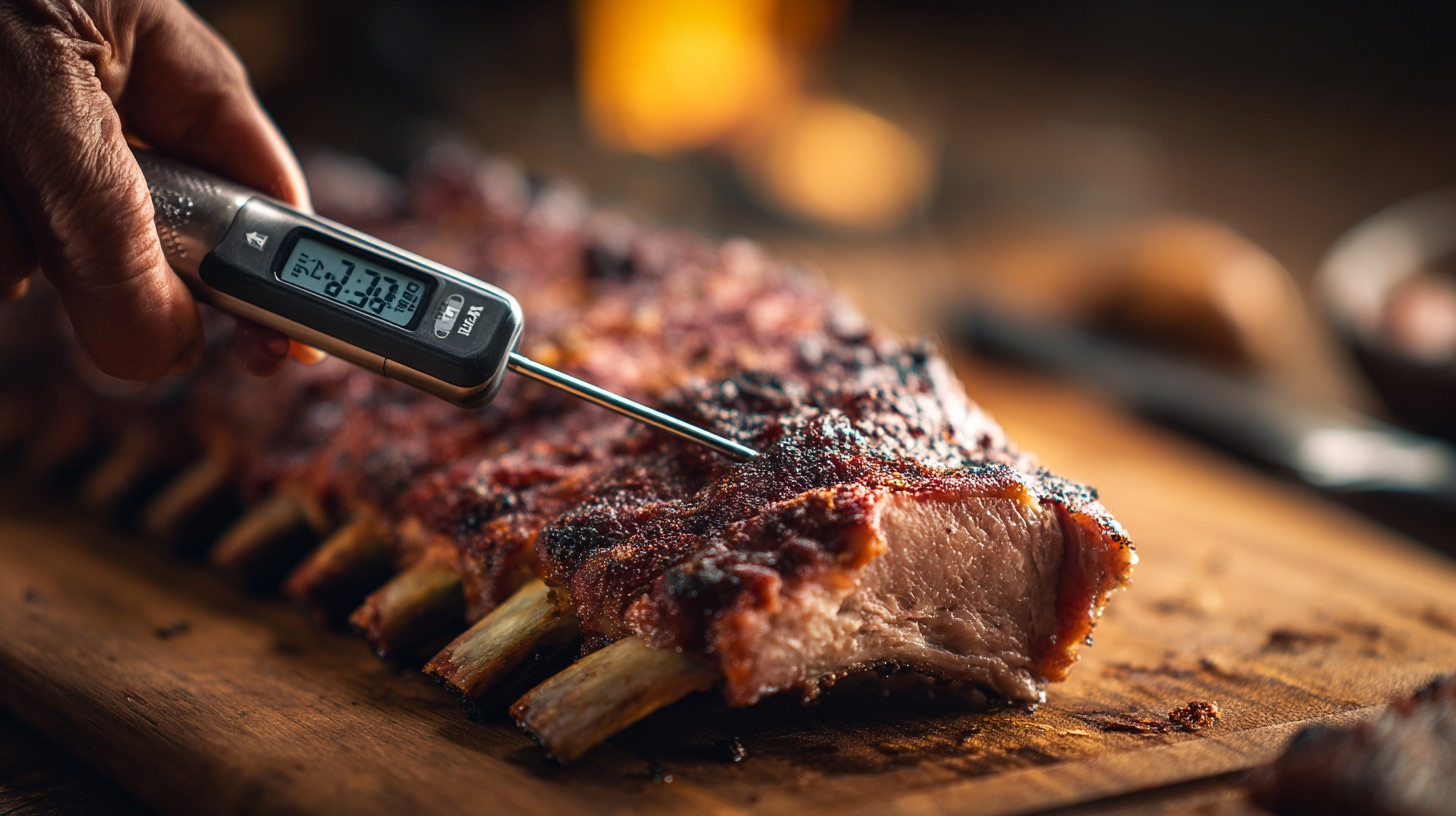
If you’ve ever pulled ribs at 145°F because that’s the safe pork temperature, you already know how that ended: safe to eat, and tough as a belt.
Ribs are the cut where safe and done are two completely different numbers, roughly 55 degrees apart. Understanding why is the difference between guessing and nailing them every time.
The Two Numbers
| Question | Temperature | What it means |
|---|---|---|
| When are ribs safe? | 145°F plus a 3-minute rest | The USDA minimum for pork chops, roasts and ribs. Bacteria are dealt with. |
| When are ribs done? | 195–203°F | Where collagen has broken down and the meat is tender. This is what you actually cook to. |
Cook ribs to 195–203°F. Most people land at about 200°F for pork spare ribs and closer to 195°F for baby backs, which are leaner and go from tender to mushy faster.
Why Ribs Aren’t Like Steak
A steak is tender to begin with, so you cook it just enough to be safe and pleasant, and every degree past that makes it worse. Ribs are the opposite.
Ribs come from a hard-working part of the animal, laced with connective tissue that is tough and chewy on its own. That tissue is mostly collagen, and collagen doesn’t soften at 145°F — it needs sustained heat above roughly 160°F to convert into gelatin, which is what makes barbecue silky and moist rather than stringy.
That conversion takes both temperature and time. This is why “low and slow” exists as a technique: you sit the meat in the 195–203°F window long enough for the collagen to finish its work. Blast ribs to 200°F in 40 minutes and they’ll be dry and tough, because the muscle fibres squeezed out their moisture before the collagen had a chance to turn.
So the number isn’t a finish line you sprint to. It’s a destination you arrive at slowly.
Target Temperatures by Cut
| Cut | Pull temperature | Notes |
|---|---|---|
| Pork spare ribs / St. Louis cut | 200–203°F | More fat and connective tissue; forgiving at the top of the range. |
| Pork baby back ribs | 195–200°F | Leaner and thinner. Overshoot and they go mushy and fall apart. |
| Pork rib tips | 200–205°F | Heavy cartilage needs the extra push to soften. |
| Beef short ribs | 203–207°F | Very high collagen; they need to go further than pork. |
| Beef back ribs | 200–203°F | Less meat between the bones, so they get there faster. |
Where to Put the Thermometer
Ribs are awkward to probe, which is why so many people get a wrong reading and blame the recipe.
- Go in from the side, parallel to the bones, into the thickest meat between two of them.
- Never touch bone. Bone runs hotter than the meat around it and will read 10–15°F high, which is how people pull ribs that turn out tough.
- Check three or four spots. A rack is uneven — the thick end can be 15°F ahead of the thin end.
- Use the thickest section as your reading, since that’s the last part to finish.
A thin-probe instant-read thermometer is worth having for this. A thick supermarket dial probe tears a wide channel through a thin rack of baby backs and lets juice out, and it’s slow enough that the reading drifts while you hold the lid open.
Temperature Isn’t the Only Test
Here’s the part most temperature charts leave out: with ribs, feel beats the number. Pitmasters use temperature to know when to start checking, then judge doneness by texture.
The Bend Test
Pick the rack up at one end with tongs, about a third of the way along, and let it hang. Ribs that are done will bow deeply and the surface will crack across the top. Ribs that stay stiff need more time. Ribs that break apart in the tongs have gone too far.
The Toothpick or Probe Test
Slide a toothpick or a thin probe into the meat between the bones. When ribs are ready it goes in and out with almost no resistance, the way a probe slides into room-temperature butter. Any grabbing or springiness means the collagen isn’t finished.
Bone Pull-Back
Meat shrinks off the bone ends as it cooks. A quarter to half an inch of exposed bone is a good sign, though it varies enough by how the butcher trimmed the rack that it should never be your only test.
Use all three together. Temperature tells you when to start checking around 195°F; the probe test tells you when to pull.
“Fall Off the Bone” Is Usually a Mistake
Ribs that literally fall off the bone are overcooked by competition standards. Properly cooked ribs hold onto the bone until you bite, then release cleanly, leaving a neat bite mark behind.
That said, plenty of people prefer them falling apart, and that’s a legitimate preference rather than an error. If that’s your target, take them to 205–207°F and expect them to be soft and shreddy. Just don’t chase that texture by accident and then wonder why the meat is mushy.
The Stall, and Why Your Ribs Stopped Climbing
Somewhere around 150–170°F the temperature can flatten out and sit there for an hour or more. Nothing is wrong. This is evaporative cooling — moisture leaving the surface cools the meat at almost exactly the rate the smoker heats it, like sweating.
You have two options. Wait it out, and the temperature will eventually climb again on its own. Or wrap the ribs tightly in foil or butcher paper, which stops the evaporation and pushes them through — the “Texas crutch.” Wrapping is faster and gives you moister meat; it also softens the bark, so many cooks unwrap for the last stretch to firm it back up.
What you should not do is crank the heat. That dries the outside long before the inside gets where it needs to be.
Resting and Serving
Rest ribs 10 to 15 minutes, loosely tented, before slicing. Longer than that and you’re holding rather than resting, which has its own rules — keep them above 140°F.
Slice between the bones with a sharp knife, meat side down so you can see exactly where the bones run.
Quick Reference
- Safe: 145°F + 3 minutes rest (USDA minimum for pork)
- Tender: 195–203°F, reached slowly
- Baby backs: 195–200°F | Spares: 200–203°F | Beef short ribs: 203–207°F
- Probe between the bones, never touching bone, in the thickest spot
- Pull when the probe slides in like butter, not when the number alone says so
- Stalled at 160°F? Normal. Wait it out or wrap.
Frequently Asked Questions
What temperature are pork ribs done at?
195–203°F for tenderness, measured in the thickest meat between the bones. They are food-safe at 145°F with a 3-minute rest, but at that temperature the collagen hasn’t broken down and the ribs will be tough.
Are ribs safe to eat at 145°F?
Yes. 145°F plus a three-minute rest is the USDA safe minimum internal temperature for pork chops, roasts and ribs. Safe and tender are simply different things with this cut.
How do I know ribs are done without a thermometer?
Use the bend test: lift the rack a third of the way along with tongs and it should bow deeply with the surface cracking. Then check that a toothpick slides between the bones with no resistance. Both together are reliable, though a thermometer removes the guesswork.
Why did my ribs stop rising in temperature?
That’s the stall, usually between 150°F and 170°F. Moisture evaporating from the surface cools the meat as fast as the cooker heats it. Wait it out, or wrap the ribs in foil to push through. Don’t raise the heat.
What temperature are beef ribs done at?
Beef short ribs need 203–207°F because they carry more connective tissue than pork. Beef back ribs finish a little lower, around 200–203°F.
Should ribs fall off the bone?
Not by competition standards — properly cooked ribs cling to the bone until you bite and then release cleanly. If you prefer them falling apart, cook to 205–207°F, but know that’s past the classic target rather than the goal.
Where do I put the thermometer in ribs?
Insert it from the side, parallel to the bones, into the thickest meat between two of them, and keep the tip away from bone. Bone reads 10–15°F hotter than the surrounding meat and will make you pull the ribs early.
Never Throw Out Good Meat Again
Get the one-page BBQ cheat sheet: fridge and freezer times for every cut, safe temperatures, and the spoilage signs that are false alarms. Free, no spam.
No spam, and you can unsubscribe any time.
Related Guides
- Pork rib tips — the cut that needs the highest pull temperature.
- How to keep ribs warm after cooking — once they hit temperature too early.
- How to reheat ribs — the 165°F leftovers number.
- How to tell if ribs are bad — doneness is not the same as safety.