
Thanksgiving is the one meal a year where most people cook a bird bigger than anything else they’ll handle, on a deadline, for a house full of guests. It’s also when the food safety hotline gets busiest, and almost every call is about the same three things: thawing, timing, and leftovers.
Here’s all of it in one place, with the actual USDA numbers rather than what your uncle swears by.
Thawing: Start Earlier Than You Think
This is where most Thanksgiving problems begin, usually on the Tuesday night when someone realises the bird is still a solid block.
In the Fridge (Best)
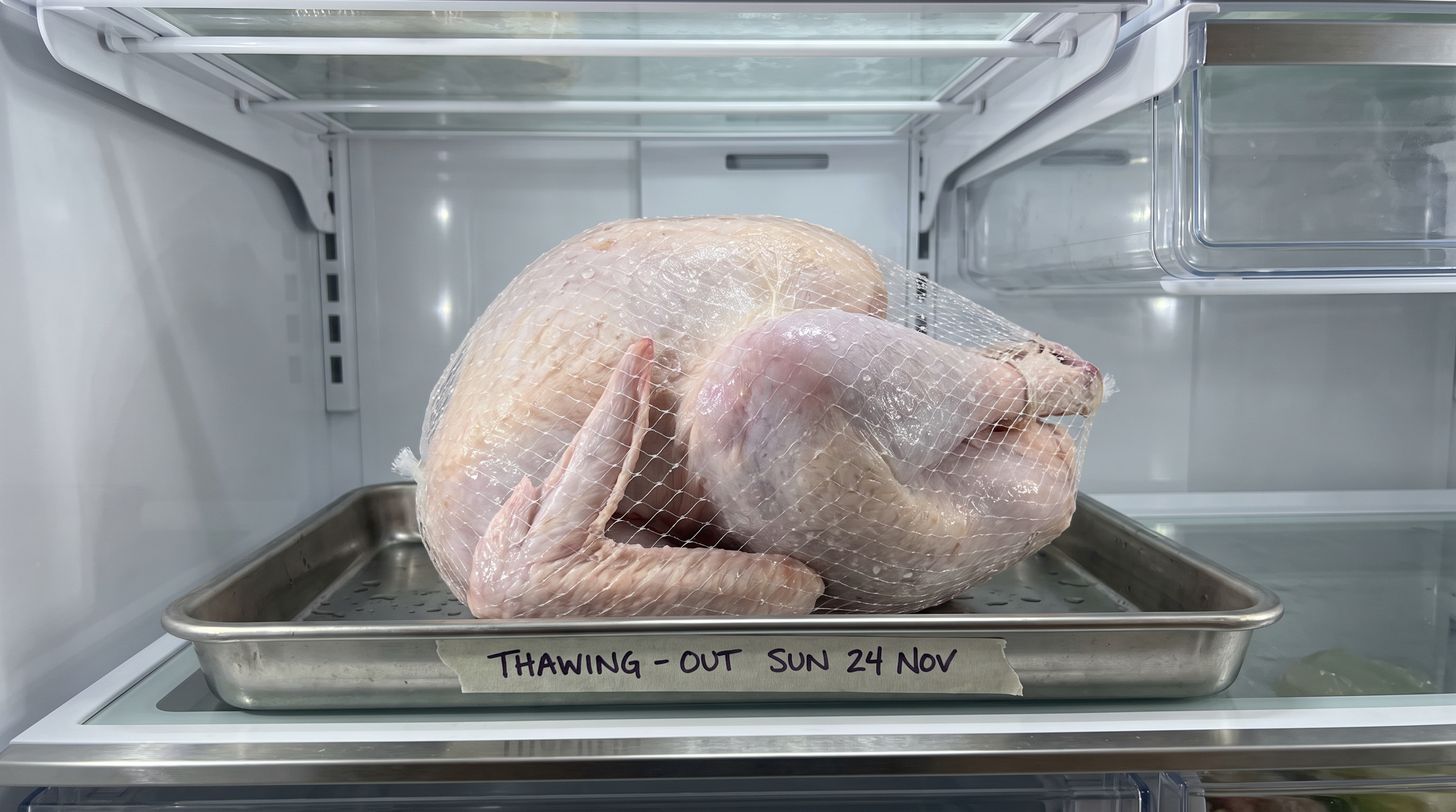
Allow 24 hours for every 5 pounds. Put the turkey on a tray on the bottom shelf so drips can’t reach anything else.
| Turkey weight | Fridge thawing time | Take it out on… |
|---|---|---|
| 4 to 12 lb | 1 to 3 days | Monday or Tuesday |
| 12 to 16 lb | 3 to 4 days | Sunday or Monday |
| 16 to 20 lb | 4 days | Sunday |
| 20 to 24 lb | 4 to 5 days | Saturday |
A fridge running at 35°F thaws more slowly than one at 40°F, so give yourself a buffer day. Once thawed this way, a turkey keeps safely for another 1 to 2 days before you cook it, and it can be refrozen without cooking if plans change.
In Cold Water (Faster)
About 30 minutes per pound. A 16-pound bird takes roughly 8 hours, which makes this a Thanksgiving-morning rescue rather than a shortcut.
- Keep the turkey in a leak-proof bag. A leaking bag lets water in and bacteria with it, and the meat goes watery.
- Submerge it fully in cold tap water. Not warm, not hot.
- Change the water every 30 minutes. This is the part people skip, and it’s what keeps the surface out of the Danger Zone.
- Cook it immediately once thawed. No putting it back in the fridge for later.
- A cold-water-thawed turkey must be cooked before refreezing.
Straight From Frozen (Yes, Really)
Forgot entirely? You can cook a turkey from frozen safely. It takes about 50% longer than the time for a thawed bird, and you’ll need to pull the giblet bag out partway through once the cavity loosens. It won’t be your best turkey, but it will be dinner, and it beats every unsafe shortcut.
Never Do This
Do not thaw a turkey on the counter, in the garage, on the porch, in the car, in a basement, in hot water, or in the dishwasher. The USDA names all of these specifically because people try all of them every November.
The reason is simple: the outside of the bird reaches Danger Zone temperature hours before the middle thaws. You end up with a warm, bacteria-friendly surface wrapped around a frozen core, and the surface is exactly where contamination lives.
Cold garage in November? Still no. Outdoor temperature swings, and you cannot hold 40°F reliably.
“I Left the Turkey Out Overnight to Thaw”
This is the single most common Thanksgiving-morning question, so here is the direct answer: throw it out.
A turkey that spent eight or ten hours on the counter has been above 40°F on its surface for most of that time. The two-hour limit was passed before you went to bed. And you cannot cook your way out of it, because certain bacteria produce toxins as they multiply that survive cooking temperatures entirely.
It hurts on a holiday. It hurts considerably less than a table full of people getting sick, several of whom are probably very young or over 65.
The one exception: a turkey still frozen solid in the middle, out for only a few hours, in a cool room. Move it to the fridge or cold water immediately and cook it that day rather than holding it. If it was out overnight, that exception doesn’t apply.
Cooking: One Number, Three Places
165°F. All poultry, every part, whole birds included.
Check it in three places: the innermost part of the thigh, the innermost part of the wing, and the thickest part of the breast. Keep the probe off the bone, which reads hotter than the meat around it.
- Pink meat is not the same as undercooked. Smoked and grilled turkey can stay pink well above 165°F, and a pink ring around the outside of smoked poultry is normal. The thermometer decides, not the colour.
- Stuffing cooked in the bird must also reach 165°F, measured in the centre. If the turkey is done and the stuffing isn’t, take the stuffing out and finish it in a dish.
- Oven temperature should never go below 325°F for roasting.
- Rest 20 minutes before carving. Carryover cooking continues, and the juices settle.
Smoking a Turkey
Smoking works beautifully for turkey, with one condition: keep the cooker hot enough. Running a smoker at 225°F leaves a big bird sitting in the Danger Zone far too long. 275 to 325°F gets you smoke flavour while moving the meat through the risky range at a sensible pace.
Skip stuffing a bird you’re going to smoke. The cavity heats too slowly at smoking temperatures for the stuffing to reach 165°F before the breast is overdone.
The Two-Hour Rule on the Table
Thanksgiving dinner tends to sprawl. People arrive late, the table sits, someone goes back for thirds at nine o’clock. Meanwhile the clock is running.
- Two hours maximum from when the food leaves the oven to when it goes in the fridge.
- Refrigerate in shallow containers, carved rather than whole. A whole carcass in a deep pot cools far too slowly in the middle.
- Don’t wait for it to cool first. Modern refrigerators handle warm food. The two hours matter more than the appliance.
- Keeping the table going for hours? Hold hot food above 140°F in a warm oven or a chafing dish rather than leaving it out.
Leftovers: How Long You Actually Have
| Item | Fridge (40°F) | Freezer (0°F) |
|---|---|---|
| Cooked turkey, carved | 3 to 4 days | 2 to 6 months |
| Smoked turkey, cooked | 3 to 4 days | 2 to 6 months |
| Gravy and stuffing | 3 to 4 days | 2 to 3 months |
| Turkey soup or stew | 3 to 4 days | 2 to 3 months |
| Raw turkey, thawed in the fridge | 1 to 2 days | Can be refrozen raw |
| Raw turkey, whole and frozen | — | 1 year for best quality |
Note how short the raw thawed window is compared to red meat: poultry gets 1 to 2 days after fridge thawing, where a pork roast gets 3 to 5. Turkey is less forgiving, and people who apply their beef instincts to a bird get caught out.
Freezer times are quality guidelines. Anything held continuously at 0°F is safe indefinitely; it just gets progressively worse to eat.
Reheating
Bring leftovers to 165°F, and add a splash of stock or gravy under foil so the meat steams rather than dries. Gravy should come to a rolling boil. Reheat only what you’re going to eat rather than the whole tray, since every cycle costs quality.
Is This Turkey Still Good?
Same tests as any meat, with one poultry-specific note.
- Slimy after rinsing? Throw it out. This is the clearest sign there is.
- Sour, sulphurous or rotten smell that doesn’t fade after the bird sits open for a few minutes? Throw it out.
- Bluish or yellow tint on raw poultry skin? That’s normal. Raw poultry ranges from bluish-white to yellow depending on breed, age and diet.
- Grey, dull or tacky raw meat with an off smell? Gone.
- Past four days cooked? Discard it regardless of how it looks.
A Thanksgiving Timeline That Works
- Saturday/Sunday: turkey out of the freezer and into the fridge, on a tray, bottom shelf.
- Wednesday: check that it’s thawed. If it isn’t, cold water finishes the job at 30 minutes per pound.
- Thursday morning: bird out of the fridge no more than an hour before it goes in the oven.
- Cooking: oven at 325°F or above, or smoker at 275–325°F. Verify 165°F in thigh, wing and breast.
- Serving: two-hour clock starts. Set a timer if the meal is going long.
- Within two hours: carve everything, shallow containers, into the fridge.
- By Sunday: leftovers eaten or frozen.
In the United States, the USDA Meat and Poultry Hotline is staffed for exactly this and it’s free: 1-888-674-6854.
Frequently Asked Questions
How long does it take to thaw a turkey in the fridge?
Twenty-four hours for every 5 pounds. A 16-pound turkey needs about four days, so it should come out of the freezer on the Sunday before Thanksgiving.
Can I thaw a turkey in cold water?
Yes, at roughly 30 minutes per pound. Keep it in a leak-proof bag, fully submerged in cold tap water, and change the water every 30 minutes. Cook it immediately once it’s thawed.
Is a turkey left out overnight to thaw safe to cook?
No. Discard it. The surface sat in the Danger Zone for hours, and some bacteria produce heat-stable toxins that survive cooking, so roasting it thoroughly will not make it safe.
How long do turkey leftovers last in the fridge?
Three to four days for cooked turkey, gravy and stuffing. Freeze anything you won’t finish in that window, where it keeps good quality for two to six months.
What temperature should turkey be cooked to?
165°F, checked in the innermost thigh, innermost wing and thickest part of the breast, with the probe off the bone. Stuffing cooked inside the bird needs to reach 165°F as well.
Why is my smoked turkey still pink at 165°F?
Smoke and oven gases react with the meat and can leave poultry pink well above a safe temperature, often as a ring around the outside. If the thermometer says 165°F in all three spots, it’s done.
Can I refreeze a turkey after thawing?
If it thawed in the refrigerator and stayed cold, yes — quality drops slightly but it’s safe. A turkey thawed in cold water or a microwave has to be cooked before it can go back in the freezer.
What temperature should I smoke a turkey at?
275 to 325°F. Lower temperatures like 225°F keep a large bird in the Danger Zone longer than is sensible. Don’t stuff a turkey you plan to smoke; the cavity won’t reach 165°F in time.
Related Guides
- How to tell if ribs are bad — the same checks, on pork.
- Can you eat ribs left out overnight? — the two-hour rule in detail.
- How to reheat ribs — the 165°F leftovers method.
- How long do ribs last? — full cold-storage times.
Never Throw Out Good Meat Again
Get the one-page BBQ cheat sheet: fridge and freezer times for every cut, safe temperatures, and the spoilage signs that are false alarms. Free, no spam.
No spam, and you can unsubscribe any time.